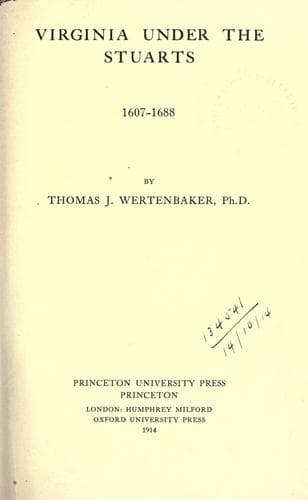
Virginia under the Stuarts 1607-1688Wertenbaker, Thomas Jefferson
History
Virginia under the Stuarts 1607-1688
Wertenbaker, Thomas Jefferson
Virginia -- History -- Colonial period, ca. 1600-1775
Edward Digges, who succeeded Mr. Bennett, seems to have had no clash
with the Assembly, but during the next administration, when Samuel
Matthews was Governor, the executive made a determined effort to break
the power of the Burgesses. At the session of 1658, the Governor and the
Council sent a message to the Assembly declaring that body
dissolved.[365] This move startled the Burgesses. The royal Governors
had always possessed the right of dissolving the House, but no such
authority had been delegated to the new executive. Moreover, it was
inconsistent with the theory, upon which everyone had acted since the
surrender in 1652, that all power resided in the representatives of the
people. "The said disolution," replied the House, "as the case standeth
is not presidentall neither legall according to the lawes, now in force,
Therefore wee humbly desire a revocation of the said declaration."[366]
Although the Burgesses replied thus courteously they were deeply
angered. Rightly judging this to be a challenge to their power, they
resolved to show once more that they were supreme in the government.
They voted, therefore, to ignore the dissolution. And it was ordered
that if any member left his seat he was to be censured "as a person
betraying the trust reposed in him by his country".[367] An oath of
secrecy was administered to all present, while the Speaker was directed
to "sign nothing without the consent of the major part of the house".
Staggered by the determined attitude of the Burgesses, the Governor and
Council at once showed signs of weakening. They were willing, they said,
to allow the Assembly to continue its deliberations, provided the work
were brought to a speedy conclusion. The "dispute of the power of
disolving and the legality thereof" they wished to refer to the Lord
Protector. But the House resolved unanimously that this answer was
unsatisfactory. The withdrawal of the dissolution was not enough, the
Governor and Council must acknowledge that their act was illegal and
therefore had never taken effect. "The House, unsatisfied with these
answers, appointed a committee to draw up a report for the manifestation
and vindication of the Assembly's power which after presentation to the
House to be sent to the Governour and Councell."[368] This committee
recommended the immediate dismissal of the Council, and proposed
resolutions declaring the "power of government to reside in such persons
as shall be impowered by the Burgesses (the representatives of the
people) who are not dissolvable by any power now extant in Virginia, but
the House of Burgesses". Upon receiving this report the House proceeded
to annul "all former election of Governour and Councill". Since the
executive had presumed to abuse its authority by defying the body that
had appointed it to office, it must be removed to evince to all the
supremacy of the House. The Burgesses seem not to have laid the blame
for this crisis upon the Governor, but upon some of the Councillors, who
Public-domain text, read in full here on John Shaqi.
Reviews
Reviews
No reviews yet
Be the first to share your thoughts on this work.
Elsewhere in the archive
Join the Discussion
Join the discussion
Sign in to leave a comment or review.
Sign InorCreate an account