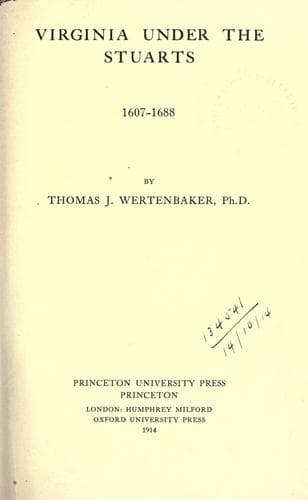
Virginia under the Stuarts 1607-1688Wertenbaker, Thomas Jefferson
History
Virginia under the Stuarts 1607-1688
Wertenbaker, Thomas Jefferson
Virginia -- History -- Colonial period, ca. 1600-1775
were endeavoring to make their own power supreme in the government.
Colonel Matthews was, therefore, reëlected, and invested with "all just
rights and privileges belonging to the Governour and Captain Generall of
Virginia".[369]
Fearing that the Council might offer resistance to their decrees, the
Burgesses commanded the serjeant-at-arms of the Assembly and the
sheriffs of James City county not to execute any warrant, precept or
command from any other person than the Speaker of the House. The
Secretary of State, Colonel William Claiborne, was directed to deliver
up the public records. But the Governor and Council seem not to have
thought of resistance, and submitted to the recall and to a new election
by the Assembly. Although they had just resolved that "for the future
none bee admitted a councellor but such who shall be nominated,
appointed and confirmed by the house", the Burgesses now allowed the
Governor to propose to them a list of names for the new Council. It
would seem that Nathaniel Bacon and Francis Willis were regarded as the
instigators of the dissolution, for they were the only members of the
Council which had signed the offensive order who were not now
reëlected.[370]
When the Assembly met again, in March, 1659, it found that its supremacy
was once more threatened. A letter had been received from Henry
Lawrence, President of the Council of State in the home government,
which seemed to imply that the Governor and his Council and not the
Burgesses, were to hold the chief power in Virginia. Lawrence declared
that the "looseness" of affairs in the colony had induced Cromwell to
take active steps for the settlement of its constitution, but that these
measures had been brought to a sudden halt by the Lord Protector's
death. The matter was, however, still before the Council of State, and
the colony might soon expect some definite orders from its
deliberations. In the meanwhile, he wrote, "their Lordships do will and
require you the present Governour and Councill there to apply yourselves
... to the peaceable and orderly management of the affairs of that
collony, according to such good lawes and customes as have been
heretofore used and exercised among you".[371]
The Burgesses were deeply agitated by this letter. They at once passed
resolutions promising to obey the commands of the Council of State, but
they determined to write the new Lord Protector, Richard Cromwell,
asking that the privileges of the Burgesses be confirmed. In this crisis
the Governor gave striking evidence of his liberal inclinations by
coming before the House to promise them his support. "He acknowledged
the supream power of electing officers to be by the present lawes
resident in the Grand Assembly", and offered to "joyne his best
assistance with the countrey in makeing an addresse to his Highnesse for
confirmation of their present priviledges".[372]
Public-domain text, read in full here on John Shaqi.
Reviews
Reviews
No reviews yet
Be the first to share your thoughts on this work.
Elsewhere in the archive
Join the Discussion
Join the discussion
Sign in to leave a comment or review.
Sign InorCreate an account