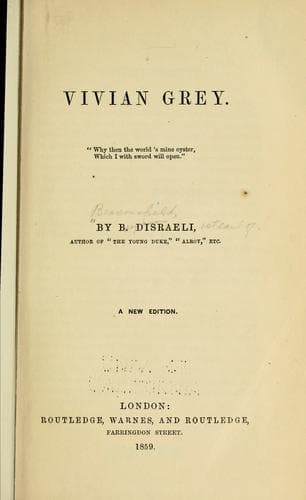
Vivian GreyDisraeli, Benjamin, Earl of Beaconsfield
ReligionIslamic
Vivian Grey
Disraeli, Benjamin, Earl of Beaconsfield
Bildungsromans; British -- Europe -- Fiction; Political fiction; Politicians -- Fiction; Young men -- Fiction
“A fall in stocks! and halt to ‘the spread of knowledge!’ and ‘the
progress of liberal principles’ is like that of a man too late for
post-horses. A fall in stocks! and where are your London Universities,
and your Mechanics’ Institutes, and your new Docks? Where your
philosophy, your philanthropy, and your competition? National prejudices
revive as national prosperity decreases. If the Consols were at 60 we
should be again bellowing, God save the King! eating roast beef, and
damning the French.”
“And you imagine literature is equally affected, Grey?”
“Clearly. We were literary because we were rich. Amid the myriad of
volumes which issued monthly from the press, what one was not written
for the mere hour? It is all very well to buy mechanical poetry and
historical novels when our purses have a plethora; but now, my dear
fellow, depend upon it, the game is up. We have no scholars now, no
literary recluses, no men who ever appear to think. ‘Scribble, scribble,
scribble’ as the Duke of Cumberland said to Gibbon, should be the motto
of the mighty ‘nineteenth century.’”
“Southey, I think, Grey, is an exception.”
“By no means. Southey is a political writer, a writer for a particular
purpose. All his works, from those in three volumes quarto to those in
one duodecimo, are alike political pamphlets.”
“We certainly want a master-spirit to set us right, Grey. We want
Byron.”
“There was the man! And that such a man should be lost to us at the very
moment that he had begun to discover why it had pleased the Omnipotent
to have endowed him with such powers!”
“If one thing were more characteristic of Byron’s mind than another, it
was his strong, shrewd, common sense; his pure, unalloyed sagacity.”
“You knew him, I think, Cleveland?”
“Well, I was slightly acquainted with him when in England; slightly,
however, for I was then very young. But many years afterwards I met him
in Italy. It was at Pisa, just before he left that place for Genoa. I
was then very much struck at the alteration in his appearance.”
“Indeed.”
“Yes; his face was swollen, and he was getting fat. His hair was grey,
and his countenance had lost that spiritual expression which it once
eminently possessed. His teeth were decaying; and he said that if ever
he came to England it would be to consult Wayte about them. I certainly
was very much struck at his alteration for the worse. Besides, he was
dressed in the most extraordinary manner.”
“Slovenly?”
“Oh, no, no, no! in the most dandified style that you can conceive; but
not that of an English dandy either. He had on a magnificent foreign
foraging cap, which he wore in the room, but his grey curls were quite
perceptible; and a frogged surtout; and he had a large gold chain round
his neck, and pushed into his waistcoat pocket. I imagined, of course,
that a glass was attached to it; but I afterwards found that it bore
nothing but a quantity of trinkets. He had also another gold chain tight
round his neck, like a collar.”
Public-domain text, read in full here on John Shaqi.
Reviews
Reviews
No reviews yet
Be the first to share your thoughts on this work.
Elsewhere in the archive
Join the Discussion
Join the discussion
Sign in to leave a comment or review.
Sign InorCreate an account