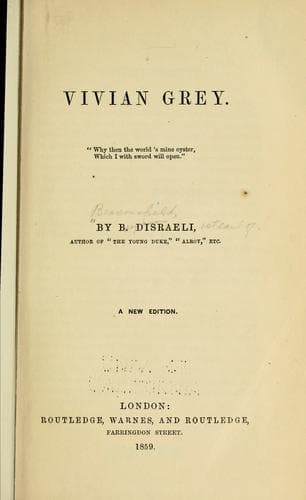
Vivian GreyDisraeli, Benjamin, Earl of Beaconsfield
ReligionIslamic
Vivian Grey
Disraeli, Benjamin, Earl of Beaconsfield
Bildungsromans; British -- Europe -- Fiction; Political fiction; Politicians -- Fiction; Young men -- Fiction
“How odd! And did you converse much with him?”
“I was not long at Pisa, but we never parted, and there was only one
subject of conversation, England, England, England. I never met a man in
whom the maladie du pays was so strong. Byron was certainly at this time
restless and discontented. He was tired of his dragoon captains and
pensioned poetasters, and he dared not come back to England with what he
considered a tarnished reputation. His only thought was of some
desperate exertion to clear himself: it was for this he went to Greece.
When I was with him he was in correspondence with some friends in
England about the purchase of a large tract of land in Colombia. He
affected a great admiration of Bolivar.”
“Who, by-the-bye, is a great man.”
“Assuredly.”
“Your acquaintance with Byron must have been one of the gratifying
incidents of your life, Cleveland?”
“Certainly; I may say with Friar Martin, in Goetz of Berlichingen, ‘The
sight of him touched my heart. It is a pleasure to have seen a
great man.’”
“Hobhouse was a faithful friend to him?”
“His conduct has been beautiful; and Byron had a thorough affection for
him, in spite of a few squibs and a few drunken speeches, which damned
good-natured friends have always been careful to repeat.”
“The loss of Byron can never be retrieved. He was indeed a real man; and
when I say this, I award him the most splendid character which human
nature need aspire to. At least, I, for my part, have no ambition to be
considered either a divinity or an angel; and truly, when I look round
upon the creatures alike effeminate in mind and body of which the world
is, in general, composed, I fear that even my ambition is too exalted.
Byron’s mind was like his own ocean, sublime in its yesty madness,
beautiful in its glittering summer brightness, mighty in the lone
magnificence of its waste of waters, gazed upon from the magic of its
own nature, yet capable of representing, but as in a glass darkly, the
natures of all others.”
“Hyde Park is greatly changed since I was a dandy, Vivian. Pray, do the
Misses Otranto still live in that house?”
“Yes; blooming as ever.”
“It is the fashion to abuse Horace Walpole, but I really think him the
most delightful writer that ever existed. I wonder who is to be the
Horace Walpole of the present century? some one, perhaps, we
least suspect.”
“Vivida Vis, think you?”
“More than probable. I will tell you who ought to be writing Memoirs;
Lord Dropmore. Does my Lord Manfred keep his mansion there, next to the
Misses Otranto?”
“I believe so, and lives there.”
“I knew him in Germany; a singular man, and not understood. Perhaps he
does not understand himself. I see our horses.”
“I will join you in an instant, Cleveland. I just want to speak one word
to Osborne, whom I see coming down here. Well, Osborne, I must come and
knock you up one of these mornings. I have got a commission for you from
Lady Julia Knighton, to which you must pay particular attention.”
Public-domain text, read in full here on John Shaqi.
Reviews
Reviews
No reviews yet
Be the first to share your thoughts on this work.
Elsewhere in the archive
Join the Discussion
Join the discussion
Sign in to leave a comment or review.
Sign InorCreate an account