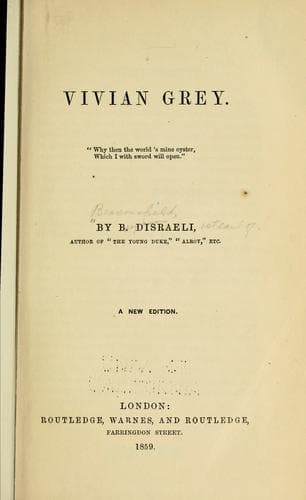
Vivian GreyDisraeli, Benjamin, Earl of Beaconsfield
ReligionIslamic
Vivian Grey
Disraeli, Benjamin, Earl of Beaconsfield
Bildungsromans; British -- Europe -- Fiction; Political fiction; Politicians -- Fiction; Young men -- Fiction
“Nay, don’t agitate yourself; we are consulting together. Let us see
what is to be done. Try to ascertain, when you are alone, what may be
the chief objects of your existence in this world. I want you to take no
theological dogmas for granted, nor to satisfy your doubts by ceasing to
think; but, whether we are in this world in a state of probation for
another, or whether we cease altogether when we cease to breathe, human
feelings tell me that we have some duties to perform; to our fellow
creatures, to our friends, to ourselves. Pray tell me, my dear boy, what
possible good your perusal of the latter Platonists can produce to
either of these three interests? I trust that my child is not one of
those who look with a glazed eye on the welfare of their fellow-men, and
who would dream away an useless life by idle puzzles of the brain;
creatures who consider their existence as an unprofitable mystery, and
yet are afraid to die. You will find Plotinus in the fourth shelf of the
next room, Vivian.”
CHAPTER VII
In England, personal distinction is the only passport to the society of
the great. Whether this distinction arise from fortune, family, or
talent, is immaterial; but certain it is, to enter into high society, a
man must either have blood, a million, or a genius.
The reputation of Mr. Grey had always made him an honoured guest among
the powerful and the great. It was for this reason that he had always
been anxious that his son should be at home as little as possible; for
he feared for a youth the fascination of London society. Although busied
with his studies, and professing “not to visit,” Vivian could not avoid
occasionally finding himself in company in which boys should never be
seen; and, what was still worse, from a certain social spirit, an
indefinable tact with which Nature had endowed him, this boy of nineteen
began to think this society delightful. Most persons of his age would
have passed through the ordeal with perfect safety; they would have
entered certain rooms, at certain hours, with stiff cravats, and Nugee
coats, and black velvet waistcoats; and after having annoyed all those
who condescended to know of their existence, with their red hands and
their white gloves, they would have retired to a corner of the room, and
conversationised with any stray four-year-older not yet sent to bed.
Public-domain text, read in full here on John Shaqi.
Reviews
Reviews
No reviews yet
Be the first to share your thoughts on this work.
Join the Discussion
Join the discussion
Sign in to leave a comment or review.
Sign InorCreate an account