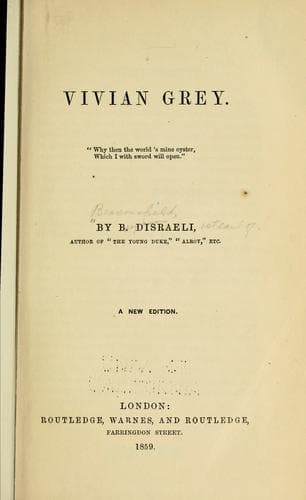
Vivian GreyDisraeli, Benjamin, Earl of Beaconsfield
ReligionIslamic
Vivian Grey
Disraeli, Benjamin, Earl of Beaconsfield
Bildungsromans; British -- Europe -- Fiction; Political fiction; Politicians -- Fiction; Young men -- Fiction
“Thought what, my dear sir? you really quite perplex me.”
“I mean to say, my Lord; I, I thought it was impossible the overtures
had been made.”
“Overtures, Mr. Vivian Grey?”
“Yes, my Lord! Overtures; has not your Lordship seen the _Post_. But I
knew it was impossible; I said so, I--”
“Said what, Mr. Vivian Grey?”
“Said that the whole paragraph was unfounded.”
“Paragraph! what paragraph?” and his Lordship rose, and rang the library
bell with vehemence: “Sadler, bring me the _Morning Post_.”
The servant entered with the paper. Mr. Vivian Grey seized it from his
hands before it reached the Marquess, and glancing his eye over it with
the rapidity of lightning, doubled up the sheet in a convenient readable
form, and pushing it into his Lordship’s hands, exclaimed, “There, my
Lord! there, that will explain all.”
His Lordship read:
“We are informed that some alteration in the composition of the present
administration is in contemplation; Lord Past Century, it is said, will
retire; Mr. Liberal Principles will have the--; and Mr. Charlatan Gas
the--. A noble Peer, whose practised talents have already benefited the
nation, and who, on vacating his seat in the Cabinet, was elevated in
the Peerage, is reported as having had certain overtures made him, the
nature of which may be conceived, but which, under present
circumstances, it would be indelicate in us to hint at.”
It would have been impossible for a hawk to watch its quarry with eyes
of more fixed and anxious earnestness than did Vivian Grey the Marquess
of Carabas, as his Lordship’s eyes wandered over the paragraph. Vivian
drew his chair close to the table opposite to the Marquess, and when the
paragraph was read, their eyes met.
“Utterly untrue,” whispered the Peer, with an agitated voice, and with
a countenance which, for a moment, seemed intellectual.
“But why Mr. Vivian Grey should deem the fact of such overtures having
been made ‘impossible,’ I confess, astonishes me.”
“Impossible, my Lord!”
“Ay, Mr. Grey, impossible, that was your word.”
“Oh, my Lord! what should I know about these matters?”
“Nay, nay, Mr. Grey, something must have been floating in your mind: why
impossible, why impossible? Did your father think so?”
“My father! Oh! no, he never thinks about these matters; ours is not a
political family; I am not sure that he ever looks at a newspaper.”
“But, my dear Mr. Grey, you would not have used the word without some
meaning. Why did you think it impossible? impossible is such a peculiar
word.” And here the Marquess looked up with great earnestness to a
portrait of himself, which hung over the fire-place. It was one of Sir
Thomas’s happiest efforts; but it was not the happiness of the likeness,
or the beauty of the painting, which now attracted his Lordship’s
attention; he thought only of the costume in which he appeared in that
portrait: the court dress of a Cabinet Minister. “Impossible, Mr. Grey,
you must confess, is a very peculiar word,” reiterated his Lordship.
Public-domain text, read in full here on John Shaqi.
Reviews
Reviews
No reviews yet
Be the first to share your thoughts on this work.
Join the Discussion
Join the discussion
Sign in to leave a comment or review.
Sign InorCreate an account