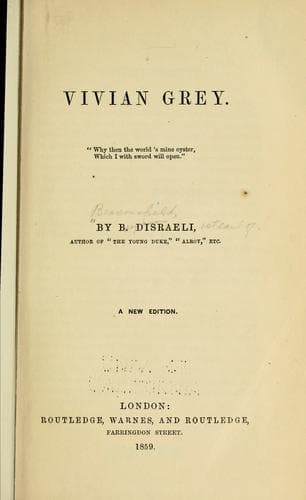
Vivian GreyDisraeli, Benjamin, Earl of Beaconsfield
ReligionIslamic
Vivian Grey
Disraeli, Benjamin, Earl of Beaconsfield
Bildungsromans; British -- Europe -- Fiction; Political fiction; Politicians -- Fiction; Young men -- Fiction
Over the gateway there rose a turreted tower, the small square window of
which, notwithstanding its stout stanchions, illumined the muniment room
of the House of Carabas. In the spandrils of the gateway and in many
other parts of the building might be seen the arms of the family; while
the tall twisted stacks of chimneys, which appeared to spring from all
parts of the roof, were carved and built in such curious and quaint
devices that they were rather an ornament than an excrescence. When you
entered the quadrangle, you found one side solely occupied by the old
hall, the huge carved rafters of whose oak roof rested on corbels of the
family supporters against the walls. These walls were of stone, but
covered half-way from the ground with a panelling of curiously-carved
oak; whence were suspended, in massy frames, the family portraits,
painted by Dutch and Italian artists. Near the dais, or upper part of
the hall, there projected an oriel window, which, as you beheld, you
scarcely knew what most to admire, the radiancy of its painted panes or
the fantastic richness of Gothic ornament, which was profusely lavished
in every part of its masonry. Here too the Gothic pendent and the Gothic
fan-work were intermingled with the Italian arabesques, which, at the
time of the building of the Château, had been recently introduced into
England by Hans Holbein and John of Padua.
How wild and fanciful are those ancient arabesques! Here at Château
Desir, in the panelling of the old hall, might you see fantastic
scrolls, separated by bodies ending in termini, and whose heads
supported the Ionic volute, while the arch, which appeared to spring
from these capitals, had, for a keystone, heads more monstrous than
those of the fabled animals of Ctesias; or so ludicrous, that you forgot
the classic griffin in the grotesque conception of the Italian artist.
Here was a gibbering monkey, there a grinning pulcinello; now you viewed
a chattering devil, which might have figured in the “Temptation of St.
Anthony;” and now a mournful, mystic, bearded countenance, which might
have flitted in the back scene of a “Witches’ Sabbath.”
A long gallery wound through the upper story of two other sides of the
quadrangle, and beneath were the show suite of apartments with a sight
of which the admiring eyes of curious tourists were occasionally
delighted.
Public-domain text, read in full here on John Shaqi.
Reviews
Reviews
No reviews yet
Be the first to share your thoughts on this work.
Join the Discussion
Join the discussion
Sign in to leave a comment or review.
Sign InorCreate an account