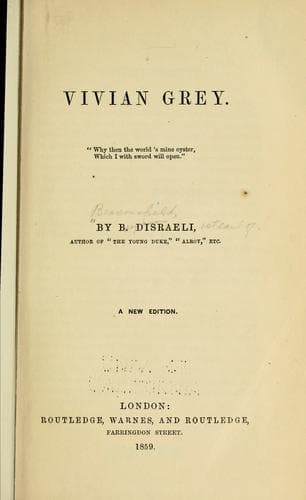
Vivian GreyDisraeli, Benjamin, Earl of Beaconsfield
ReligionIslamic
Vivian Grey
Disraeli, Benjamin, Earl of Beaconsfield
Bildungsromans; British -- Europe -- Fiction; Political fiction; Politicians -- Fiction; Young men -- Fiction
“The Duke of Waterloo?” guessed Cynthia Courtown, the romp.
“Prince Hungary?” asked her sister Laura.
“Is it a gentleman?” asked Mrs. Felix Lorraine.
“No, no, you are all wrong, and all very stupid. It is Mrs. Million.”
“Oh, how delightful!” said Cynthia.
“Oh, how annoying!” said the Marchioness.
“You need not look so agitated, my love,” said the Marquess; “I have
written to Mrs. Million to say that we shall be most happy to see her;
but as the castle is very full, she must not come with five
carriages-and-four, as she did last year.”
“And will Mrs. Million dine with us in the Hall, Marquess?” asked
Cynthia Courtown.
“Mrs. Million will do what she likes; I only know that I shall dine in
the Hall, whatever happens, and whoever comes; and so, I suppose, will
Miss Cynthia Courtown?”
Vivian rode out alone, immediately after breakfast, to cure his
melancholy by a gallop.
Returning home, he intended to look in at a pretty farm-house, where
lived one John Conyers, a great friend of Vivian’s. This man had, about
a fortnight ago, been of essential service to our hero, when a vicious
horse, which he was endeavouring to cure of some ugly tricks, had nearly
terminated his mortal career.
“Why are you crying so, my boy?” asked Vivian of a little Conyers, who
was sobbing bitterly at the floor. He was answered only with
desperate sobs.
“Oh, ‘tis your honour,” said a decent-looking woman, who came out of the
house; “I thought they had come back again.”
“Come back again! why, what is the matter, dame?”
“Oh! your honour, we’re in sad distress; there’s been a seizure this
morning, and I’m mortal fear’d the good man’s beside himself.”
“Good heavens! why did not you come to the Castle?”
“Oh! your honour, we a’nt his Lordship’s tenants no longer; there’s been
a change for Purley Mill, and now we’re Lord Mounteney’s people. John
Conyers has been behind-hand since he had the fever, but Mr. Sedgwick
always gave time: Lord Mounteney’s gem’man says the system’s bad, and so
he’ll put an end to it; and so all’s gone, your honour; all’s gone, and
I’m mortal fear’d the good man’s beside himself.”
“And who is Lord Mounteney’s man of business?”
“Mr. Stapylton Toad,” sobbed the good dame.
“Here, boy, leave off crying, and hold my horse; keep your hold tight,
but give him rein, he’ll be quiet enough then. I will see honest
John, dame.”
“I’m sure your honour’s very kind, but I’m mortal fear’d the good man’s
beside himself, and he’s apt to do very violent things when the fits on
him. He hasn’t been so bad since young Barton behaved so wickedly to
his sister.”
“Never mind! there is nothing like a friend’s face in the hour of
sorrow.”
“I wouldn’t advise your honour,” said the good dame. “It’s an awful hour
when the fit’s on him; he knows not friend or foe, and scarcely knows
me, your honour.”
“Never mind, I’ll see him.”
Public-domain text, read in full here on John Shaqi.
Reviews
Reviews
No reviews yet
Be the first to share your thoughts on this work.
Join the Discussion
Join the discussion
Sign in to leave a comment or review.
Sign InorCreate an account