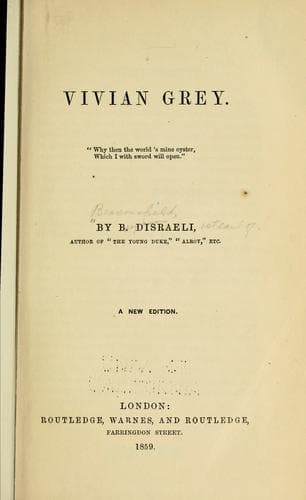
Vivian GreyDisraeli, Benjamin, Earl of Beaconsfield
ReligionIslamic
Vivian Grey
Disraeli, Benjamin, Earl of Beaconsfield
Bildungsromans; British -- Europe -- Fiction; Political fiction; Politicians -- Fiction; Young men -- Fiction
And sure I am that Vivian Grey was loved as ardently and as faithfully
as you might expect from innocent young hearts. His slight
accomplishments were the standard of all perfection, his sayings were
the soul of all good fellowship, and his opinion the guide in any crisis
which occurred in the monotonous existence of the little commonwealth.
And time flew gaily on.
One winter evening, as Vivian, with some of his particular cronies, were
standing round the school-room fire, they began, as all schoolboys do
when it grows rather dark and they grow rather sentimental, to talk
of HOME.
“Twelve weeks more,” said Augustus Etherege; “twelve weeks more, and we
are free! The glorious day should be celebrated.”
“A feast, a feast!” exclaimed Poynings.
“A feast is but the work of a night,” said Vivian Grey; “something more
stirring for me! What say you to private theatricals?”
The proposition was, of course, received with enthusiasm, and it was not
until they had unanimously agreed to act that they universally
remembered that acting was not allowed. And then they consulted whether
they should ask Dallas, and then they remembered that Dallas had been
asked fifty times, and then they “supposed they must give it up;” and
then Vivian Grey made a proposition which the rest were secretly sighing
for, but which they were afraid to make themselves; he proposed that
they should act without asking Dallas. “Well, then, we’ll do it without
asking him,” said Vivian; “nothing is allowed in this life, and
everything is done: in town there is a thing called the French play, and
that is not allowed, yet my aunt has got a private box there. Trust me
for acting, but what shall we perform?”
This question was, as usual, the fruitful source of jarring opinions.
One proposed Othello, chiefly because it would be so easy to black a
face with a burnt cork. Another was for Hamlet, solely because he wanted
to act the ghost, which he proposed doing in white shorts and a
night-cap. A third was for Julius Caesar, because the murder scene would
be such fun.
“No! no!” said Vivian, tired at these various and varying proposals,
“this will never do. Out upon Tragedies; let’s have a Comedy!”
“A Comedy! a Comedy! oh! how delightful!”
CHAPTER IV
Public-domain text, read in full here on John Shaqi.
Reviews
Reviews
No reviews yet
Be the first to share your thoughts on this work.
Join the Discussion
Join the discussion
Sign in to leave a comment or review.
Sign InorCreate an account