Produced by Stephen Hutcheson and the Online Distributed
Proofreading Team at http://www.pgdp.net
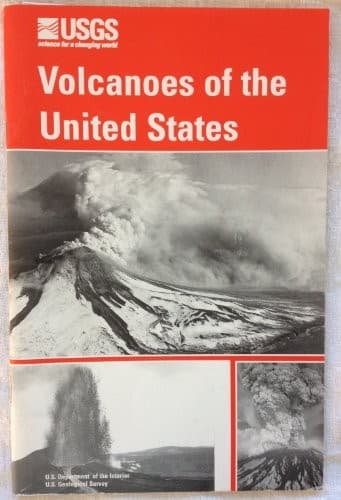
Volcanoes of the
United States
by Steven R. Brantley
For sale by the US. Government Printing Office
Superintendent of Documents, Mail Stop: SSOP, Washington, DC 20402-9328
ISBN 0-16-045054-3
[Illustration: Mount Shasta, California, has erupted at least 10 times
in the past 3,400 years and at least 3 times in the past 750 years.
(_Photograph by Lyn Topinka._)]
Introduction
Few natural forces are as spectacular and threatening, or have played
such a dominant role in shaping the face of the Earth, as erupting
volcanoes. Volcanism has built some of the world’s greatest mountain
ranges, covered vast regions with _lava_ (molten rock at the Earth’s
surface), and triggered explosive eruptions whose size and power are
nearly impossible for us to imagine today. Fortunately, such calamitous
eruptions occur infrequently. Of the 50 or so volcanoes that erupt every
year, however, a few severely disrupt human activities. Between 1980 and
1990, volcanic activity killed at least 26,000 people and forced nearly
450,000 to flee from their homes.
Though few people in the United States may actually experience an
erupting volcano, the evidence for earlier volcanism is preserved in
many rocks of North America. Features seen in volcanic rocks only hours
old are also present in ancient volcanic rocks, both at the surface and
buried beneath younger deposits. A thick ash deposit sandwiched between
layers of sandstone in Nebraska, the massive granite peaks of the Sierra
Nevada mountain range, and a variety of volcanic layers found in eastern
Maine are but a few of the striking clues of past volcanism. With this
perspective, an erupting volcano is not only an exciting and awesome
spectacle in its own right but a window into a natural process that has
happened over and over again throughout Earth’s history.
The Earth’s crust, on which we live and depend, is in large part the
product of millions of once-active volcanoes and tremendous volumes of
_magma_ (molten rock below ground) that did not erupt but instead cooled
below the surface. Such persistent and widespread volcanism has resulted
in many valuable natural resources throughout the world. For example,
volcanic ash blown over thousands of square kilometers of land increases
soil fertility for forests and agriculture by adding nutrients and
acting as a mulch. Groundwater heated by large, still-hot magma bodies
can be tapped for geothermal energy. And over many thousands of years,
heated groundwater has concentrated valuable minerals, including copper,
tin, gold, and silver, into deposits that are mined throughout the
world.
Public-domain text, read in full here on John Shaqi.
Reviews
Reviews
No reviews yet
Be the first to share your thoughts on this work.
Join the Discussion
Join the discussion
Sign in to leave a comment or review.
Sign InorCreate an account