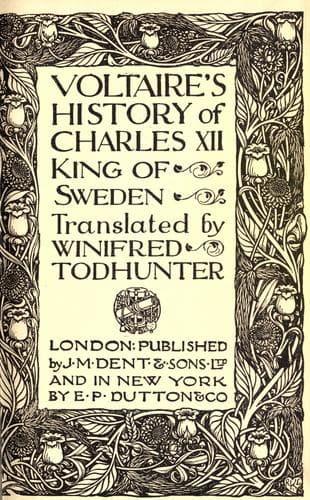
Voltaire's history of Charles XII, king of SwedenVoltaire
Philosophy
Voltaire's history of Charles XII, king of Sweden
Voltaire
Charles XII, King of Sweden, 1682-1718
“CHARLES XII” was written during the years 1727 and 1728. It is more
than 170 years since it was first translated into English. Opinions
of its merits differ widely. Macaulay, classing it with Boswell’s
“Johnson” and Marmontel’s “Mémoires,” says that it “may be perused with
delight by the most frivolous and the most indifferent.” Carlyle goes
even further: “‘Charles XII,’” he writes, “may still pass for a model
in that oft-attempted species of biography; the clearest details are
given in the fewest words; we have sketches of strange men and strange
countries, of wars, adventures, negotiations, in a style which for
graphic brevity rivals Sallust. It is a line engraving on a reduced
scale of that Swede and his mad life, without colours, yet not without
the foreshortenings and perspectives of a true picture. In respect of
composition, whatever may be said of its accuracy and worth otherwise,
we cannot but reckon it as greatly the best of Voltaire’s histories.”
Adverse criticism, on the other hand, began as early as 1732, when La
Mottraye, who had lived on terms of intimacy with the King, wrote a
scathing criticism of Voltaire’s work. Voltaire succeeded in making
a laughing-stock of this gentleman, but the publication of the works
of Nordberg, the King’s chaplain, and of Adlerfelt, his chamberlain,
shortly afterwards, did bring discredit on some of Voltaire’s details.
Of the modern school of critics, Mr. Nisbet Bain, who has made a
special study of original authorities, does not hesitate to call the
book a “romance.”
Underlying this difference of opinion is the time-honoured question
of the “scientific” as opposed to the “epical” treatment of the lives
of the great. The history of any great man’s career is a kind of epic
poem, and, to borrow Mr. Birrell’s words, “I do not see why we children
of a larger growth may not be interested in the annals of mankind
simply as a story.”
It must, indeed, be admitted that Voltaire is no precise or scientific
historian; but, in the portrayal of the life of a man of action,
rapidity and charm of style is surely as important as the careful
tracing of cause and effect.
Voltaire’s literary style is famous; but work of high literary merit
always suffers in translation; so that any roughness in the present
rendering must be attributed to the translator and not to the author.
“Ett vet jag som aldrig dör--
Det är dom öfver död man.”
One thing I know that never dies--
The verdict passed upon the dead.
Public-domain text, read in full here on John Shaqi.
Reviews
Reviews
No reviews yet
Be the first to share your thoughts on this work.
Join the Discussion
Join the discussion
Sign in to leave a comment or review.
Sign InorCreate an account