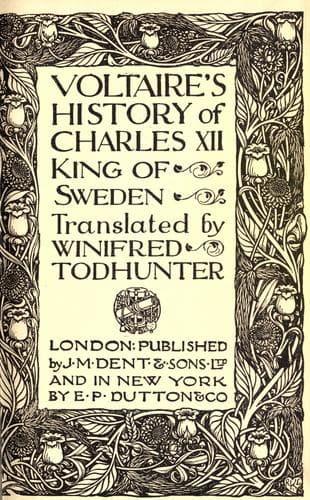
Voltaire's history of Charles XII, king of SwedenVoltaire
Philosophy
Voltaire's history of Charles XII, king of Sweden
Voltaire
Charles XII, King of Sweden, 1682-1718
He renounced all magnificence, pastimes and recreations, and reduced
his menu to the utmost frugality. He had affected display in dress, but
in future wore the uniform of a common soldier. There had been a rumour
that he had entertained a passion for a lady of the Court. But whether
this was true or not, it is certain that he abstained from the society
of women for ever after, not only to avoid coming too much under their
influence, but that he might prove to his soldiers his determination to
live under the severest discipline; possibly, too, he wished to pose as
the only Prince who had conquered so difficult a temptation. He also
resolved to abstain from wine for the rest of his life. Some people say
that he made this resolve in order to curb nature in every particular,
and to add a new virtue to his heroism; but the majority say that he
took this means of punishing himself for an excess which he had once
committed, leading to an insult offered to a lady at table in the
presence of his mother. If that was so, his self-condemnation and the
life-long deprivation which he imposed on himself are none the less to
be admired.
He began operations by a promise of relief to his brother-in-law,
the Duke of Holstein. Eight thousand men were immediately sent to
Pomerania, a province bordering on Holstein, to protect the Duke
against the attacks of the Danes. The Duke certainly needed them; his
dominions were already ravaged, his castle at Gottorp taken and the
town of Tonning closely besieged, the King of Denmark being there
in person, to enjoy a conquest of which he felt certain. This spark
enflamed the empire. On one side the Saxon troops of the King of Poland
and those of Brandenburg, Volfenbuttel and Hesse-Cassel marched to join
the Danes. On the other the King of Sweden’s 8,000 men, the troops of
Hanover and Zell, and three Dutch regiments came to the help of the
Duke.
While the little country of Holstein was thus made the theatre of war
two squadrons, one from England and the other from Holland, appeared in
the Baltic.
These two States were guarantors of the treaty of Altena, which the
Danes had broken, and they were all the more eager to relieve the
oppressed Duke, as it was to the interest of their trade to prevent
the growth of the power of the King of Denmark. For they knew that the
Danes, when they once had control of the Sound, would lay heavy dues on
the trading nations, as soon as they were strong enough to do so.
The English and the Dutch had, for this reason, kept, as far as
possible, the balance of power equal between the princes of the North;
they joined the King of Sweden, who seemed on the point of being
overwhelmed by many enemies acting in concert, and helped him for the
same reason that the others attacked him, viz. because they thought him
incapable of self-defence.
Public-domain text, read in full here on John Shaqi.
Reviews
Reviews
No reviews yet
Be the first to share your thoughts on this work.
Join the Discussion
Join the discussion
Sign in to leave a comment or review.
Sign InorCreate an account