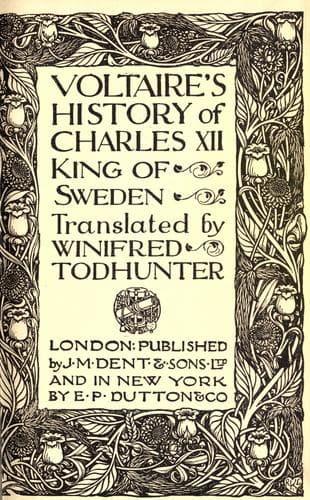
Voltaire's history of Charles XII, king of SwedenVoltaire
Philosophy
Voltaire's history of Charles XII, king of Sweden
Voltaire
Charles XII, King of Sweden, 1682-1718
“Och än är det likt det slägte som bor
Bland Nordiska fjellar och dalar,
Och ännu på Gud och på Stålet det tror,
An fädernas kärnspråk det talar.”
“And still as of old are the folk that abide
‘Mid northerly mountain and valley;
In God and their weapons they ever confide,
To voice of their fathers they rally.”
INTRODUCTION
THE “Life of Charles XII” that Mr. John Burns once bought for a penny
in the New Cut--an incident in itself historical if one looks at it in
the right way--was, he writes to say, an English version of Voltaire’s
book. The “Histoire de Charles XII, Roi de Suède,” was first published
at Rouen in 1731, first freely translated into English by Alexander
Henderson in 1734, and soon afterwards reduced into a chap-book, which
made the King a proverbial hero in English fairs and market-places.
There have been other translations since Henderson’s, and it is now
retranslated by Miss Todhunter with a closer correspondence than his to
Voltaire’s original.
The book may claim a particular right to an English hearing, apart from
the main interest of its subject. It was in England that the life of
Charles XII was written by Voltaire, when he was on a visit of exigency
there after the Rohan escapade and his second Bastille imprisonment.
The effect of this stay in England was that of a determining event
in his career. “Voltairism,” writes Mr. John Morley, “may be said to
have begun from the flight of its founder from Paris to London. This,
to borrow a name from the most memorable instance of outward change
marking inward revolution, was the decisive ‘hegira,’ from which the
philosophy of destruction in a formal shape may be held seriously
to date.” We may supplement this passage from the criticism of a
French critic of another school, who says, “England at this time was
worked by a spirit of dogmatic irreligion which based itself on a
false erudition, a bold criticism and an insidious metaphysic. It was
the time of Woolston, of Toland, of Tindal, of Chubb, of Collins, of
Bolingbroke. Until then, an _insouciant_ disciple and imitator
of the epicureans of the Temple and the _roués_ of the Regency,
Voltaire had only ventured on impiety by sallies; dogmas and mysteries
had so far only inspired him with _bon mots_. In the school of the
English philosophers he learnt to reason out his incredulity.”
Public-domain text, read in full here on John Shaqi.
Reviews
Reviews
No reviews yet
Be the first to share your thoughts on this work.
Join the Discussion
Join the discussion
Sign in to leave a comment or review.
Sign InorCreate an account