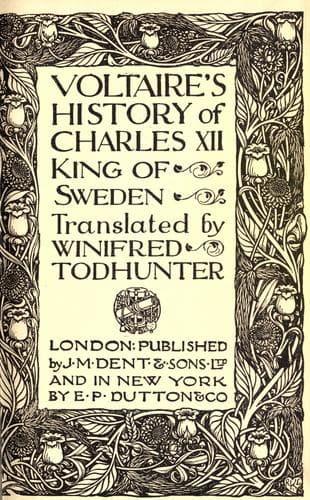
Voltaire's history of Charles XII, king of SwedenVoltaire
Philosophy
Voltaire's history of Charles XII, king of Sweden
Voltaire
Charles XII, King of Sweden, 1682-1718
The Czar had assembled the best part of his troops in this spot and
had entrenched himself to advantage; his aim was to hinder the Swedes
from crossing the river. Charles placed some of his regiment on the
banks of the Berezine, close to Borislou, as though he intended to
attempt the crossing in face of the enemy. At the same time he led
his army about three leagues up the river, threw a bridge across it,
cut his way through a body of 3,000 men who defended that post, and
marched straight against the enemy without a halt. The Russians did not
wait for his arrival, but immediately decamped and withdrew towards
Borysthenes, spoiling all the roads, and destroying all on their line
of march, so that they might at least delay the Swedes’ advance.
Charles surmounted all difficulties, continually advancing towards
Borysthenes. On his way he met 20,000 Russians, entrenched at a spot
called Hollosin, behind a marsh, which could not be reached without
crossing a river. Charles did not wait till the rest of his infantry
had arrived to make the attack, but threw himself into the water at the
head of his foot-guards, and crossed the river and the morass, though
the water was sometimes above his shoulders. While he thus attacked the
enemy, he ordered his cavalry to pass round the morass and take them in
the flank.
The Russians, amazed that no barrier could defend them, were
simultaneously routed by the King on foot, and by the Swedish horse.
The horse, having made their way through the enemy, joined the King in
the midst of the fray. He then mounted, but some time after, finding a
young Swedish noble named Gyllenstein, for whom he had great affection,
wounded in the fray and unable to walk, he insisted on his taking his
horse, and continued to command on foot at the head of his infantry.
Of all the battles he had ever fought, this was in all probability the
most glorious--that in which he was exposed to the greatest risks, and
in which he showed the greatest ability. The memory of it is kept by a
medal with the inscription, “Silvæ, paludes, aggeres, hostes, victi” on
one side and “Victrices copias alium laturus in orbem” on the other.
The Russians, driven out everywhere, recrossed the Borysthenes,
which separates Poland from their own country. Charles lost no time
in following them; he crossed the great river after them at Mohilou,
the last town in Poland, which is sometimes in the hands of the Poles,
sometimes in those of the Czar, after the usual fate of frontier places.
The Czar, seeing his empire, into which he was introducing arts and
commerce, becoming a prey to a war which might in a short time ruin
his plans, and perhaps lose him his throne, was thinking of peace, and
even made proposals by a Polish nobleman whom he sent to the Swedish
army. Charles, who had been unaccustomed to granting peace to his enemy
except in their capitals, only replied, “I will treat with the Czar at
Moscow.”
Public-domain text, read in full here on John Shaqi.
Reviews
Reviews
No reviews yet
Be the first to share your thoughts on this work.
Elsewhere in the archive
Join the Discussion
Join the discussion
Sign in to leave a comment or review.
Sign InorCreate an account