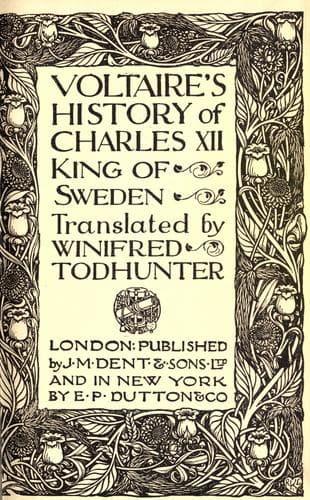
Voltaire's history of Charles XII, king of SwedenVoltaire
Philosophy
Voltaire's history of Charles XII, king of Sweden
Voltaire
Charles XII, King of Sweden, 1682-1718
When the Czar heard this haughty answer, “My brother Charles,” he said,
“would still pose as Alexander, but I flatter myself he will find me no
Darius.”
From Mohilou, where the King crossed the Borysthenes, turning north
along the river, upon the frontiers of Poland and Russia, is situated
the country of Smolensko, through which lies the main road from Poland
to Moscow. The Czar fled by this road, and the King followed by forced
marches. Part of the Russian rearguard was more than once engaged with
the dragoons of the Swedish vanguard. Generally the latter got the
advantage, but they weakened themselves by these skirmishes, which
were never decisive, and always meant the loss of some of their men.
On the 22nd of September this year, 1708, the King attacked a body of
ten thousand horse and six thousand Calmouks near Smolensko.
These Calmouks are Tartars, living between Astrakan, which is part
of the Czar’s dominions, and Samarcande, the country of the Usbeck
Tartars. The Calmouks’ country stretches from the east to the mountains
which separate the Mogul from the western part of Asia. Those who
dwell near Astrakan are tributary to the Czar. He pretends to absolute
dominion over them, but their wandering life hinders him from subduing
them, and forces him to treat them as the Grand-Seignior treats the
Arabs, sometimes bearing with their robberies, and at others punishing
them.
There are always some of the Calmouks in the Russian army, and the Czar
had even succeeded in reducing them to discipline like the rest of his
soldiers.
The King fell on this army with only six regiments of horse and four
thousand infantry; he broke the Russian ranks at the head of his
Ostrogothic regiment and forced the enemy to retreat. The King advanced
upon them by rough and hollow ways where the Calmouks lay hid; they
then appeared and threw themselves between the regiment where the King
was fighting and the rest of the Swedish army. In an instant both
Russians and Calmouks had surrounded this regiment and made their
way close up to his Majesty. They killed two aides-de-camp who were
fighting near him. The King’s horse was killed under him, and as one
of the equerries was offering him another, both equerry and horse were
struck dead on the spot. Charles fought on foot, surrounded by some of
his officers who immediately hastened to rally round him.
Public-domain text, read in full here on John Shaqi.
Reviews
Reviews
No reviews yet
Be the first to share your thoughts on this work.
Elsewhere in the archive
Join the Discussion
Join the discussion
Sign in to leave a comment or review.
Sign InorCreate an account