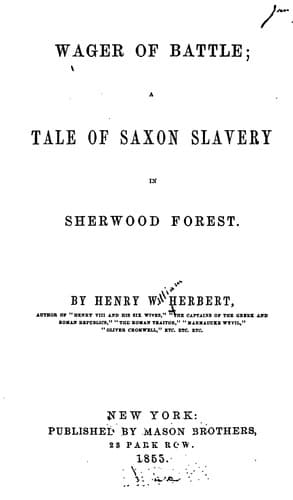
Wager of Battle: A Tale of Saxon Slavery in Sherwood ForestHerbert, Henry William
History
Wager of Battle: A Tale of Saxon Slavery in Sherwood Forest
Herbert, Henry William
Anglo-Saxons -- Fiction; Great Britain -- History -- Norman period, 1066-1154 -- Fiction; Sherwood Forest (England) -- Fiction
Efforts were made immediately to track the assassins by the slot,
several, both of the men-at-arms and of the Yorkshire foresters, being
expert at the art; but their skill was at fault, as well as the scent
of the slow-hounds, which were laid on the trail; for, within a few
hundred yards of the spot, the party had entered the channel of the
river Idle, and probably followed its course upward, to a place where
it flowed over a sheet of hard, slaty, rock; and where the land
farther back consisted of a dry, sun-burned, upland waste, of short,
summer-parched turf, which took no impression of the horses' hoofs.
There was no proof, nor any distinct circumstantial evidence; yet none
doubted any more than if they had beheld the doing of the dastardly
deed, that the good Lord de Morville had fallen by the hand of Sir
Foulke d'Oilly and of his associates in blood-shedding.
For the rest, the good knight lay dead, leaving no child, wife,
brother, nor any near relation, who should inherit either his honors
or his lands. He had left neither testament nor next of kin.
Literally, he had died, and made no sign.
The offices of the church were done duly, the masses were chanted over
the dead, and the last remains of the good knight were consigned to
dust in the chapel vaults of his ancestral castle, never to descend to
posterity of his, or to bear his name again forever.
In a few days it was made known that Sir Philip had died deeply
indebted to the Jews of York, of Tadcaster, even of London; that his
estates, all of which were unentailed and in his own right, were
heavily mortgaged; and that the lands would be sold to satisfy the
creditors of the deceased. Shortly after, it was whispered abroad, and
soon proclaimed aloud, that Sir Foulke d'Oilly had become purchaser of
whatever was saleable, and had been confirmed by the royal mandate in
the possession of the seigneurial and feudal rights of the lapsed fief
of Waltheofstow. There had been none to draw attention to the
suspicions which weighed so heavily against Sir Foulke in the
neighborhood, and among the followers of the dead knight; they were
men of small rank and no influence, and had no motive to induce them
wantonly to incur the hatred of the most powerful and unscrupulous
noble of the vicinity, by bringing charges which they had no means to
substantiate, if true, and which, to disprove, it was probable that he
had contrivances already prepared by false witness.
Public-domain text, read in full here on John Shaqi.
Reviews
Reviews
No reviews yet
Be the first to share your thoughts on this work.
Elsewhere in the archive
Join the Discussion
Join the discussion
Sign in to leave a comment or review.
Sign InorCreate an account