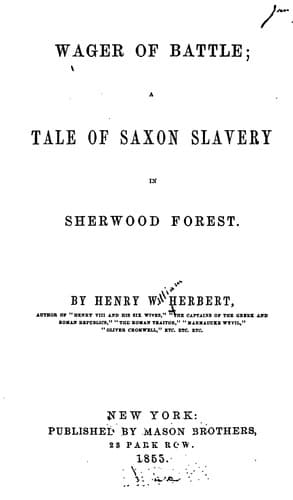
Wager of Battle: A Tale of Saxon Slavery in Sherwood ForestHerbert, Henry William
History
Wager of Battle: A Tale of Saxon Slavery in Sherwood Forest
Herbert, Henry William
Anglo-Saxons -- Fiction; Great Britain -- History -- Norman period, 1066-1154 -- Fiction; Sherwood Forest (England) -- Fiction
Noon came, and the dinner hour, but the knight came not to the banquet
hall--evening fell, and there were no tidings; but, at nightfall,
Eadwulf came in, pale, ghastly, and terrified, and announced that the
knight and the esquire both lay dead with their horses in a glade of
the wood, not far from the scene of the quarrel of the preceding day,
on the banks of the river Idle. No time was lost. With torch and
cresset, bow and spear, the household hurried, under their appointed
officers, to the fatal spot, and soon found the tidings of the serf to
be but too true.
The knight and his horse lay together, as they had fallen, both
stricken down at the same instant, in full career as it would seem, by
a sudden and instantaneous death-stroke. The warrior, though
prostrate, still sat the horse as if in life; he was not unhelmed; his
shield was still about his neck; his lance was yet in the rest, the
shaft unbroken, and the point unbloodied--the animal lay with its legs
extended, as if it had been at full speed when the fatal stroke
overtook it. A barbed cloth-yard arrow had been shot directly into its
breast, piercing the heart through and through, by some one in full
front of the animal; and a lance point had entered the throat of the
rider, above the edge of the shield which hung about his neck, coming
out between the shoulders behind, and inflicting a wound which must
have been instantaneously mortal.
Investigation of the ground showed that many horses had been concealed
or ambushed in a neighboring dingle, within easy arrow-shot of the
murdered baron; that two horsemen had encountered him in the glade,
one of whom, he by whose lance he had fallen, had charged him in full
career.
It was evident to the men-at-arms, that Sir Philip's charger had been
treacherously shot dead in full career, by an archer ambushed in the
brake, at the very moment when he was encountering his enemy at the
lance's point; and that, as the horse was in the act of falling, he
had been bored through from above, before his own lance had touched
the other rider.
The esquire had been cut down and hacked with many wounds of axes and
two-handed swords, one of his arms being completely severed from the
trunk, and his skull cleft asunder by a ghastly blow. His horse's
brains had been dashed out with a mace, probably after the slaughter
of the rider; and that this part of the deed of horror had been
accomplished by many armed men, dismounted, and not by the slayer of
De Morville, was evident, from the number of mailed and booted
footsteps deeply imprinted in the turf around the carcasses of the
murdered men and butchered animals.
Public-domain text, read in full here on John Shaqi.
Reviews
Reviews
No reviews yet
Be the first to share your thoughts on this work.
Elsewhere in the archive
Join the Discussion
Join the discussion
Sign in to leave a comment or review.
Sign InorCreate an account