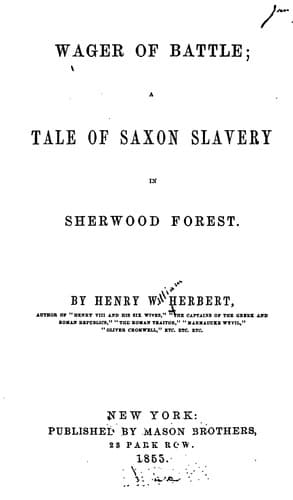
Wager of Battle: A Tale of Saxon Slavery in Sherwood ForestHerbert, Henry William
History
Wager of Battle: A Tale of Saxon Slavery in Sherwood Forest
Herbert, Henry William
Anglo-Saxons -- Fiction; Great Britain -- History -- Norman period, 1066-1154 -- Fiction; Sherwood Forest (England) -- Fiction
Every thing was ominous of a storm, but every thing as yet was calm,
tranquil, and peaceful. In the very quiet, however, there was
something awful, something that seemed to whisper of coming horror.
The wide sands lay gray and leaden at the feet of the observer,
reflecting the lowering clouds which overhung them, except where the
brassy glare of the horizon tinged their extreme verge with an angry
rust-colored hue, that seemed to partake the nature of shadow rather
than of light.
The face of the Saxon fell as he gazed over the fearful waste, beyond
which lay his last hope of safety; for, though he had never before
seen those treacherous sands, he had learned much of their nature,
especially from the outlaws, with whom he found his last shelter; and
he knew, that to cross them certainly and in safety, the passenger on
foot should set out with the receding tide, so as to reach the mid
labyrinth of oozy channels and half-treacherous sand banks, through
which the scanty and divided rivers of the fair lakeland found their
way oceanward, when the water was at its lowest ebb.
Instead of this, however, so heavily had he slept toward morning, the
utter weariness of his limbs and exhaustion of his body having
completely conquered the watchfulness of his anxious mind, that the
tide had so long run out, leaving the sands toward the shore,
especially at this upper end of the bay, bare and hard as a beaten
road, that it might well be doubted whether it had not already turned,
and might not be looked for, ere he could reach the mid-channel,
pouring in, unbroken, as it is wont to do in calm weather, over those
boundless flats, with a speed exceeding that of horses.
There was no time for delay, however; for, from the report of the
horseman who had overtaken him just before twilight, he could not
doubt that his pursuers had not halted for the night farther than five
or six miles in his rear; so that their arrival might be looked for at
any moment, on any one of the headlands along the shore, whence they
would have no difficulty in discerning him at several miles distance,
while traveling over the light-colored surface of the sands.
Onward, therefore, he hastened, as fast as his weary limbs could carry
him, hardly conscious whether he was flying from the greater danger,
or toward it. He had a strong suspicion that the flood would be upon
him ere he should reach the channel of Kent; and that he should find
it an unfordable river, girdled by pathless quicksands. He knew,
however, that be his chances of escape what they might by persisting
onward, his death was as certain, by strange tortures, as any thing
sublunary can be called certain, should the Normans overtake him,
red-handed from what they were sure to regard as recent murder.
Public-domain text, read in full here on John Shaqi.
Reviews
Reviews
No reviews yet
Be the first to share your thoughts on this work.
Elsewhere in the archive
Join the Discussion
Join the discussion
Sign in to leave a comment or review.
Sign InorCreate an account