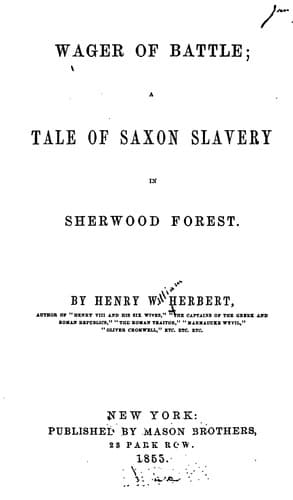
Wager of Battle: A Tale of Saxon Slavery in Sherwood ForestHerbert, Henry William
History
Wager of Battle: A Tale of Saxon Slavery in Sherwood Forest
Herbert, Henry William
Anglo-Saxons -- Fiction; Great Britain -- History -- Norman period, 1066-1154 -- Fiction; Sherwood Forest (England) -- Fiction
On, therefore, he fled into the deceitful waste. At first, the sands
were hard, even, and solid, yet so cool and damp under the worn and
blistered feet of the wretched fugitive, that they gave him an
immediate sense of pleasurable relief and refreshment; and for three
or four miles he journeyed with such ease and rapidity as, compared to
the pain and lassitude with which on the past days he had stumbled
along, over the stony roads, and across the broken moors, that his
heart began to wax more cheerful, and his hopes of escape warmed into
something tangible and real.
Ere long, the sun rose clear above the eastern fog-banks, and all
seemed still fair and tranquil; the sands, dry as yet, and firm,
smiled golden-bright under the increasing warmth and lustre of the
day, and the little rivulets, by which the fresh waters oozed to the
deep, glittered like silver ribbons, checkering the yellow expanse.
The very gulls and terns, as they swooped joyously about his head,
screaming and diving in the sunny air, or skimmed the sands in pursuit
of such small fry as might have been left by the retreat of the
waters, seemed, by their activity and happiness, to give him fresh
hope and strength to support it.
Occasionally he turned, and cast a hurried glance toward the hills he
had just left, down which the slant rays were streaming, to the limit
where the green grass and scattered shrubs gave way to the bare
sea-sands; and, as from each anxious scrutiny of the ground, he
returned to his forward progress without discovering any signs of
peril, his face lighted up anew, and he advanced with a freer and a
bolder foot.
Still so weary was he, and so worn with his past toils, that he made
but little real progress; and when he had been already an hour on the
sands, he had accomplished little more than three miles of his route.
The sands, from the point at which he had entered them, over against
the city of Lancaster, and almost due west from that city to the
nearest accessible headland of the opposite shore, were not less than
nine miles in extent, the deepest and most dangerous parts being those
nearest to the farther coast; but, measured to the place for which he
was making, a considerable distance up the estuary of the Kent, they
were at least three miles longer.
Public-domain text, read in full here on John Shaqi.
Reviews
Reviews
No reviews yet
Be the first to share your thoughts on this work.
Elsewhere in the archive
Join the Discussion
Join the discussion
Sign in to leave a comment or review.
Sign InorCreate an account