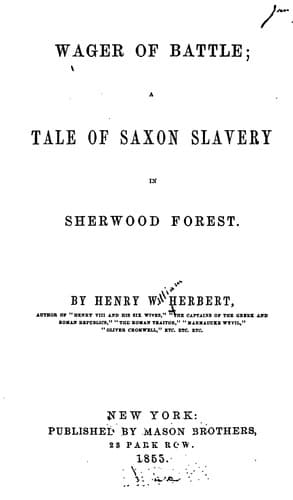
Wager of Battle: A Tale of Saxon Slavery in Sherwood ForestHerbert, Henry William
History
Wager of Battle: A Tale of Saxon Slavery in Sherwood Forest
Herbert, Henry William
Anglo-Saxons -- Fiction; Great Britain -- History -- Norman period, 1066-1154 -- Fiction; Sherwood Forest (England) -- Fiction
Two or three channels the fugitive had already crossed, and was
rejoiced at finding the sandy bottom, over which the fresh water
flowed some two or three inches deep, perfectly hard and beaten; at
the end of his third mile he reached a broader expanse of water, where
the sands were covered to the width of a hundred yards, and where the
current, if that might be called a current which had scarcely any
perceptible motion downward, took him nearly to the midleg. The
foothold was, moreover, less firm than before, and his heavy brogues
sank to the latchet in the yielding soil. This was the course of the
first and smaller of the two rivers which fall into the eastern side
of the bay from the county of Lancaster, and at about two miles
distant, he could see the course of the second, glittering blue among
the low sand-rollers which divided them.
Here he paused, undecided, for a few moments. He knew not what should
be the depth of the water, or what the nature of the bottom; yet
already he almost doubted, almost feared, that the time was passed,
and that the tide had turned.
He looked southward, in the direction of the sea, which lay broad in
view, though at many leagues distance; and, for the first time, it
struck him that he could hear the moaning roll of its ever restless
waves. He fancied, too, that the sands looked darker and more plashy,
and that the silvery line which marked the margin of the waters, where
the sun glinted on their quiet ripples, appeared nearer than when he
had descended from the solid strand.
But, on the other hand, the sun-lighted slopes and crags of the
opposite Lancastrian shore, near Flockborough Head, and the green
point of Westmoreland, between the mouths of Windermere and the river
Kent, lying in the full blaze of the unintercepted morning, looked
much nearer than they really were, and seemed to beckon him forward
with a smile of welcome. "Even if it be that the tide is turning," he
thought, "I have yet the time to outstrip it; and, the quicker it
mount, the wider the barrier it will place between me and my enemies."
Almost as these ideas passed his mind, a sound came to his ears, which
banished in a moment every thought of the time, the tide, the peril of
the sands.
It was the keen blast of a bugle, clearly winded on the shore from
which he had just departed, but at a point a little higher up, to the
northward, than that at which he had himself left it. In an instant,
before he had even the time to turn round and take observation, a
second bugle, yet farther to the north, took up the cadence, and, as
that died away, yet a third, so faint, and so far to the northward,
that it seemed like a mere echo of the first, replied.
Public-domain text, read in full here on John Shaqi.
Reviews
Reviews
No reviews yet
Be the first to share your thoughts on this work.
Elsewhere in the archive
Join the Discussion
Join the discussion
Sign in to leave a comment or review.
Sign InorCreate an account