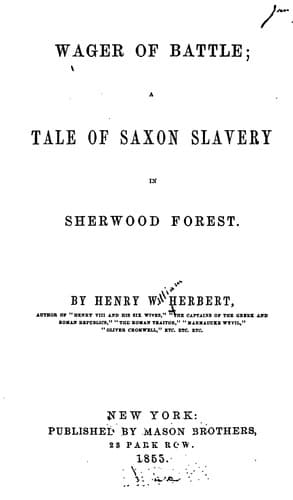
Wager of Battle: A Tale of Saxon Slavery in Sherwood ForestHerbert, Henry William
History
Wager of Battle: A Tale of Saxon Slavery in Sherwood Forest
Herbert, Henry William
Anglo-Saxons -- Fiction; Great Britain -- History -- Norman period, 1066-1154 -- Fiction; Sherwood Forest (England) -- Fiction
"I will take this opportunity of observing, that they who have studied
the appearances of nature feel that the superiority, in point of
visual interest, of mountainous over other countries, is more
strikingly displayed in winter than in summer. This, as must be
obvious, is partly owing to the forms of the mountains, which, of
course, are not affected by the seasons, but also, in no small degree,
to the greater variety that exists in their winter than their summer
coloring. This variety is such, and so harmoniously preserved, that it
leaves little cause of regret when the splendor of the season has
passed away. The oak coppices, upon the sides of the mountains, retain
russet leaves; the birch stands conspicuous with its silver stems and
puce-colored twigs; the hollies, with green leaves and scarlet
berries, have come forth into view from among the deciduous trees,
whose summer foliage had concealed them; the ivy is now plentifully
apparent upon the stems and boughs of the trees, and among the wooded
rocks. In place of the uniform summer-green of the herbage and fern,
many rich colors play into each other over the surface of the
mountains; turf, the tints of which are interchangeably tawny-green,
olive, and brown, beds of withered fern and gray rocks being
harmoniously blended together. The mosses and lichens are never so
flourishing as in winter, if it be not a season of frost; and their
minute beauties prodigally adorn the foreground. Wherever we turn, we
find these productions of nature, to which winter is rather favorable
than unkindly, scattered over the walls, banks of earth, rocks and
stones, and upon the trunks of trees, with the intermixture of several
species of small fern, now green and fresh; and, to the observing
passenger, their forms and colors are a source of inexhaustible
admiration."--WORDSWORTH.
Thus far have I quoted the accurate and simple language of the great
Poet of the Lakes, since, none other that I can choose would place
before the eyes of my readers so vivid a reality of the scenery of
that loveliest portion of picturesque England, in its finest aspect.
It was not, indeed, quite so deep in the season, that all the changes
so beautifully depicted above had yet occurred, when, late in a clear
autumnal evening, Kenric and Edith stood together in the porch of
their new home, gazing across the tranquil bosom of the little mere,
and down the pastoral valley of the Kent, yet the face of the picture
was close to that described in the quotations. The trees, in the level
ground and in the lower valleys, had not lost all their verdure,
though the golden, the russet, and the ruddy-red, had intermingled
largely with the green; the meadows, by the water-edge, had not
changed a tint, a shade of their summer glory, but all the hill-sides
were as they stand painted by the poet-pen of the child of Nature.
Public-domain text, read in full here on John Shaqi.
Reviews
Reviews
No reviews yet
Be the first to share your thoughts on this work.
Elsewhere in the archive
Join the Discussion
Join the discussion
Sign in to leave a comment or review.
Sign InorCreate an account