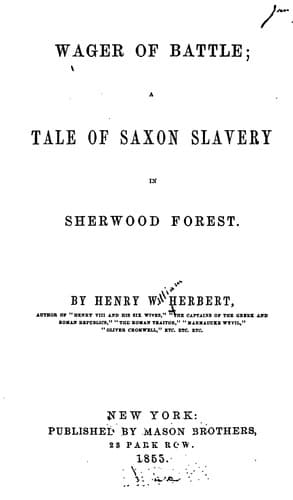
Wager of Battle: A Tale of Saxon Slavery in Sherwood ForestHerbert, Henry William
History
Wager of Battle: A Tale of Saxon Slavery in Sherwood Forest
Herbert, Henry William
Anglo-Saxons -- Fiction; Great Britain -- History -- Norman period, 1066-1154 -- Fiction; Sherwood Forest (England) -- Fiction
The sun was setting far away, to the right hand, as they gazed down
the long dale to the southward, behind the mighty tops of Hawkshead
and Blackcomb, which towered against the gorgeous golden-sky, flecked
with a thousand glowing cloudlets, orange and rosy-red, and glaring
crimson, like a huge perpendicular wall of dusky purple; with the long
basin of Windermere, visible from that elevation over the lower
intervening ridges, lying along their bases as it seemed, though in
truth many miles distant, a sheet of beaten-gold. The lower hills, to
the west of Kentmere, downward to Bowness, whose chapel-window gleamed
like fire in the distance, were shrouded in soft purple haze, and
threw long blue shadows across the rich vale, broken by the slant
golden beams which streamed through the gaps in their summits, in
far-reaching pencils of misty light. At the same time, the little lake
of Kentmere lay at the feet of the spectators, still, clear, and
transparent as an artificial mirror, giving back a counterfeit
presentment of every thing around and above it, only less real than
the actual reality; while toward the precipitous and craggy hills,
behind them and on their left, the westering sun sent forth such
floods of rosy and golden light as illuminated all their projections
and cavities, bringing them, with all their accidents of crag or
coppice, ivy-bush or silvery birch-tree, close to the eye of the
beholder, blended with an intermixture of solemn shadows, seen
distinctly through the clear atmosphere.
Over this scene the happy couple gazed with such feelings as none can
gaze, but they who are good and happy. The sleepy hum of the good
mother's wheel came drowsily through the open doorway; the distant
laugh and cry of the hunter's boys, as they were clearing the kennels
and feeding the hounds for the night, with an occasional bay or
whimper of their impatient charges, rose pleasantly on the night air.
Most of the natural sounds and sights had ceased; the songs of the
birds were silent, for the nightingales visit not those valleys of the
west; the bleat of the flocks was heard no more; the lowing of the
herds had passed homeward; only a few late swallows skimmed the bosom
of the mere, which a leaping trout would break, now and then, with a
loud plash, into a silvery maze of circling dimples; and the jarring
note of the nighthawk, as his swift wing glanced under the brown
shadows of the oak, in chase of the great evening moths, was heard in
the gloaming; and the pinions of the great golden-eagle hung like a
shadow, leagues up in the burning sky.
Perfect contentment was the breathing spirit of the calm and gentle
scene, with something of that heavenly peace which induced the friend
of Izaak Walton to apostrophize the Sabbath, as
"Sweet day, so calm, so pure, so bright,
The bridal of the earth and sky;"
Public-domain text, read in full here on John Shaqi.
Reviews
Reviews
No reviews yet
Be the first to share your thoughts on this work.
Elsewhere in the archive
Join the Discussion
Join the discussion
Sign in to leave a comment or review.
Sign InorCreate an account