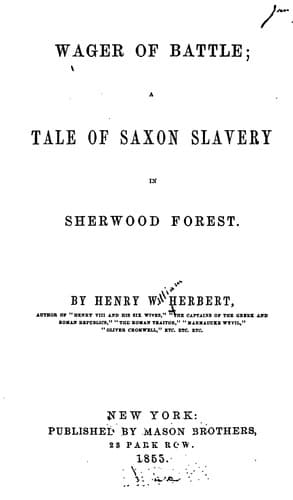
Wager of Battle: A Tale of Saxon Slavery in Sherwood ForestHerbert, Henry William
History
Wager of Battle: A Tale of Saxon Slavery in Sherwood Forest
Herbert, Henry William
Anglo-Saxons -- Fiction; Great Britain -- History -- Norman period, 1066-1154 -- Fiction; Sherwood Forest (England) -- Fiction
And the sunny room was pleasant; and the light played cheerfully on
the polished pewter trenchers on the dresser, and the varnished holly
and scarlet berries, and bright wild-flowers on the wall; and the
sparkling wood fire was not amiss after the gallop in the clear air;
and Guendolen preferred the light, foaming mead of the Saxon
housewife, to the wines of Gascony and Bordeaux; and all went happily
and well.
Above all, Edith gained her point. She got occasion to tell the tale
of Eadwulf's flight, arrival, and departure, and obtained a promise of
protection for her husband, in case he should be brought in question
for his share in his brother's escape; and even prevailed that no
search should be made after Eadwulf, provided he would keep himself
aloof, and commit no offense against the pitiless forest laws, or
depredations on the people of the dales.
Many strange emotions of indignation, sympathy, horror, alternately
swept through the mind of Guendolen, and were reflected from her
eloquent eyes; and many times did Aradas twirl his thick mustache, and
gripe his dagger's hilt, as they heard the vicissitudes of that
strange tale--the base and dastardly murder of the noble and good Sir
Philip de Morville; the slaying of the bailiff by the hand of Eadwulf,
which thus came to look liker to lawful retribution than to mere
homicide; the strange chances of the serf's escape; the wonderful
wiles by which he had baffled the speed of horses and the scent of
bloodhounds; and the final catastrophe of the sands, swallowing up, as
it would seem, well-nigh all the slaughterers of Sir Philip, while
sparing the panting and heart-broken fugitive. It was indeed a tale
more strange and horrible than any thing, save truth.
They sat some time in silence, musing. Then suddenly, as by an
impulse, their eyes met. Their meaning was the same.
"Yes!" he said, bowing his head gravely, in answer to what he read in
her look, "there may be an occasion, and a very noble one."
"And for such an one, I will bind my glove on your casque, and buckle
your sword to your side very gladly."
"Amen!" said he. "Be it as God wills. He will defend the right."
So, bidding their pretty hostess adieu, not leaving her without a
token of their visit and good-will, they mounted and rode homeward,
thinking no more of the sport; graver, perhaps, and more solemn in
their manner; but, on the whole, happier and more hopeful than when
they set forth in the morning.
And Edith, though she understood nothing of the impulses of their
hearts, was grateful and content; and when her husband returned home,
and, hanging about his neck, she told him what she had done, and how
she had prospered, and received his approbation and caresses, was that
night the happiest woman within the four seas that gird Britain.
CHAPTER XXI.
THE ARREST.
_Count._ If thou be he, then thou art prisoner.
_Tal._ Prisoner to whom?
SHAKESPEARE.
Public-domain text, read in full here on John Shaqi.
Reviews
Reviews
No reviews yet
Be the first to share your thoughts on this work.
Elsewhere in the archive
Join the Discussion
Join the discussion
Sign in to leave a comment or review.
Sign InorCreate an account