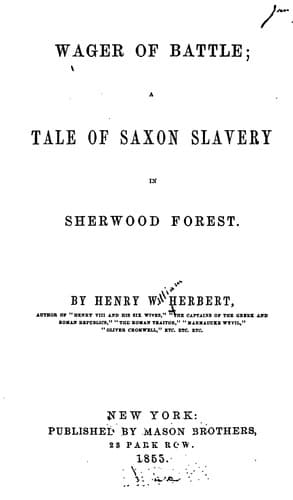
Wager of Battle: A Tale of Saxon Slavery in Sherwood ForestHerbert, Henry William
History
Wager of Battle: A Tale of Saxon Slavery in Sherwood Forest
Herbert, Henry William
Anglo-Saxons -- Fiction; Great Britain -- History -- Norman period, 1066-1154 -- Fiction; Sherwood Forest (England) -- Fiction
For several days after the visit of the Lady Guendolen and her lover
to the house of the verdurer of Kentmere, rumors, many of which had
been afloat since the catastrophe on the sands, began to increase
among the dalesmen, of strangers seen at intervals among the hills or
in the scattered hamlets, seeming to observe every thing, but
themselves carefully avoiding observation, asking many questions, but
answering none, and leaving a general impression on the minds of all
who saw them, that they were thus squandered, as it were, through the
lake country, as spies, probably of some marauding band, but certainly
with no good intent. These individuals bore no sort of resemblance, it
was said, or affinity one to the other, nor seemed to have any league
of community between them, yet there was an unanimous sentiment,
wherever they came and went, which they ordinarily did in succession,
that they were all acting on a common plan and with a common purpose,
however dissimilar might be their garb, their occupation, or their
immediate purpose. And widely dissimilar these were--for one of those
suspected was in appearance a maimed beggar, displaying the
scallop-shell of St. James of Compostella, in token that he had
crossed the seas for his soul's good, and vowing that he had lost his
left arm in a sanguinary conflict with the Saracens, who were
besieging Jerusalem, in the valley of Jehoshaphat; a second was a
dashing pedler, with gay wares for the village maidens, and costlier
fabrics--lawns from Cyprus, and silks and embroideries of Ind, for the
taste of nobler wearers; another seemed a mendicant friar, though of
what order it was not by any means so evident, since, his tonsure
excepted, his apparel gave token of very little else than raggedness
and filth.
Nearly a week had passed thus, when, at a late hour in the afternoon,
word was conveyed to the castle of Sir Yvo, under Hawkshead, by the
bailiff, in person, of the little town of Kendal, which lay about
midway between Kentmere and the bay, that a small body of horse,
completely armed, having at their head a gentleman apparently of rank,
had entered the town about mid-day, demanded quarters for the night
for man and horse, and sent out one or two unarmed riders, as if to
survey the country. In any part of England traversed by great roads,
this would have created no wonder or surmise; for hundreds of such
parties were to be seen on the great thoroughfares every day, few
persons at that period journeying without weapons of offense and arms
defensive, and gentlemen of rank being invariably attended by bodies
of armed retainers, which were indeed rendered indispensable by the
prevalence of private feuds and personal hostilities which were never
wholly at an end between the proud barons, whose conterminous lands
were constant cause of unneighborly bickerings and strife.
Public-domain text, read in full here on John Shaqi.
Reviews
Reviews
No reviews yet
Be the first to share your thoughts on this work.
Elsewhere in the archive
Join the Discussion
Join the discussion
Sign in to leave a comment or review.
Sign InorCreate an account