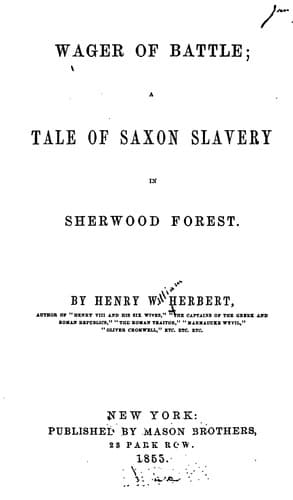
Wager of Battle: A Tale of Saxon Slavery in Sherwood ForestHerbert, Henry William
History
Wager of Battle: A Tale of Saxon Slavery in Sherwood Forest
Herbert, Henry William
Anglo-Saxons -- Fiction; Great Britain -- History -- Norman period, 1066-1154 -- Fiction; Sherwood Forest (England) -- Fiction
Strange times! when to be permitted to engage in a conflict, in which
there was no alternative but victory, or infamy and death, was
esteemed a favor, and was sought for, as a boon, not by strong men and
soldiers only, but by delicate and gentle girls, in behalf of their
betrothed lovers, as a mode of winning _los_ on earth, and glory
everlasting in the heavens.
Yet so it was; and when it was told to Guendolen, that her lover was
nominated to that dreadful enterprise, a blush, indeed, mantled to her
cheek, and a thrill ran through all her quivering frame, and an
unbidden tear trembled in her beautiful clear eye; but the blush, and
the thrill, and the tear, were of pride and excitement, not of fear or
compassion; and the lady never slept sounder or more sweetly than on
that eventful night, when she learned that, beyond a peradventure, her
true love would be sleeping, within ten little days, under a bloody
and dishonorable sod, or living, the winner of those golden-spurs and
of her own peerless beauties.
There was, however, a strange mixture of simple and fervent faith in
those days, with an infinitely larger amount of coarse and open
wickedness, violence, and vice, than, perhaps, ever prevailed in any
other age. And while the moral restraint on men's conduct and actions,
arising from a sense of future responsibility and retribution, was
vastly inferior to what now exists, owing to the open sale of
indulgences, absolutions, and dispensations, and the other abominable
corruptions of the Romish church, the belief in temporal judgments,
and the present interference of divine justice in the affairs of men,
was almost universal.
Infidelity in those days was a madness utterly unknown; and an
atheist, materialist, or any phase of what we now call a free-thinker,
would have been regarded with greater wonder than the strangest
physical monster. It is not too much to say, that there were not in
that day twenty men in England, who did not believe in the real
efficacy of the ordeals, whether by water, fire, or battle, in
discovering the truth, or one in a thousand who would not be
half-defeated, before entering the lists, by the belief that God was
fighting against him, or strengthened unto victory by the confidence
that his cause was just.
One of these one men in a thousand it was, however, about to be the
fortune of Aradas de Ratcliffe to encounter, in the person of Sir
Foulke d'Oilly; but this he neither knew, nor would have thought of
twice, had he known it. However hardened the heart of his adversary
might be by the petrifying effects of habitual vice, however dulled
his conscience by impunity and arrogance and self-relying contumacy,
his own was so strongly panoplied in conscious honesty, so bucklered
by confidence in his own good cause, so puissant by faith in God, that
he no more feared what the might of that bad man could do against him,
than he doubted the creed of Christ and his holy apostles.
Public-domain text, read in full here on John Shaqi.
Reviews
Reviews
No reviews yet
Be the first to share your thoughts on this work.
Elsewhere in the archive
Join the Discussion
Join the discussion
Sign in to leave a comment or review.
Sign InorCreate an account