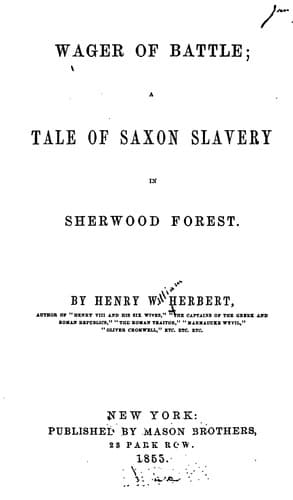
Wager of Battle: A Tale of Saxon Slavery in Sherwood ForestHerbert, Henry William
History
Wager of Battle: A Tale of Saxon Slavery in Sherwood Forest
Herbert, Henry William
Anglo-Saxons -- Fiction; Great Britain -- History -- Norman period, 1066-1154 -- Fiction; Sherwood Forest (England) -- Fiction
Nor less was the undoubting assurance of the lady of his love, in
whom, to her faith in divine justice, to her absolute conviction of
d'Oilly's damning guilt, was added that over-weening confidence in her
lover's absolute superiority, not only to all other men in general,
but to every other man individually, which was common to love-sick
ladies in those days of romance and chivalry.
But we must not anticipate, nor indeed is there cause to do so; for
the days flew; until, after leaving Kendal Castle, the old fortalice
of Yvo de Taillebois, who, coming in with the Conqueror, had wedded
the sister of the Earls Morcar and Edwin, whence they took their
departure as so much nearer to their destination, and journeying four
pleasant winter days round the head of Morecambe Bay, they entered the
old town of Lancaster. Sir Yvo de Taillebois was borne in a
horse-litter, in consequence of his accident, at the head of a dozen
knights, his vassals, all armed cap-à-pie; and a hundred spears of
men-at-arms followed, with thrice as many of the already famous Kendal
archers, escorting a long train of litters, conveying the lady and her
female attendants, and a yet longer array of sumpter-mules and
pack-horses.
The town was already crowded; but for a party so distinguished as that
of Sir Yvo de Taillebois, High-Sheriff of the North-western counties,
and chief local officer of the crown, apartments were prepared in the
castle, adjoining those of the high justiciary and the itinerant, or,
as we should now call them, circuit judges; while his train easily
found quarters, some among the garrison of which they formed a part,
as of right, and the rest in the vicinity of the castle.
At an early hour in the morning, preceded by trumpets and javelin men,
clad in all the magnificence of scarlet and ermine, emblematic of
judicial purity, but unencumbered by the hideous perukes of horse-hair
which later ages have devised for the disfigurement of forensic
dignitaries, the high justiciary, Ranulf de Glanville, followed by his
five associate judges, proceeded to the superb oak-wainscoted and
oak-groined hall, in which it was used to hold the sittings of "the
King's court," at that time the highest tribunal in the realm.
Public-domain text, read in full here on John Shaqi.
Reviews
Reviews
No reviews yet
Be the first to share your thoughts on this work.
Elsewhere in the archive
Join the Discussion
Join the discussion
Sign in to leave a comment or review.
Sign InorCreate an account