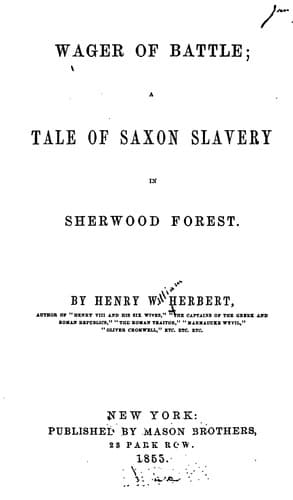
Wager of Battle: A Tale of Saxon Slavery in Sherwood ForestHerbert, Henry William
History
Wager of Battle: A Tale of Saxon Slavery in Sherwood Forest
Herbert, Henry William
Anglo-Saxons -- Fiction; Great Britain -- History -- Norman period, 1066-1154 -- Fiction; Sherwood Forest (England) -- Fiction
This noble apartment, which was above a hundred feet in length by half
that width, and measured sixty feet from the floor to the spring of
the open arches, independent of the octagon lantern in the center,
beneath which burned nearly a ton of charcoal, in a superb brazier of
carved bronze, was crowded from the floor to the light, flying
galleries, with all the flower of the Northern counties, ladies as
well as knights and nobles, attracted by one of those untraceable but
ubiquitous rumors, which so often precede remarkable events, to the
effect that something of more than ordinary moment was likely to occur
at the present assize. Among this noble assemblage, all of whom rose
to their feet, with a heavy rustle of furred and embroidered robes,
and a suppressed murmur of applause, as the judges entered,
conspicuous on the right-hand side of the nave was Sir Foulke d'Oilly,
attended by two or three barons and bannerets of his immediate train,
and not less than twenty knights, who held fiefs under him.
What, however, was the astonishment of the assembly, when, after the
guard of pensioners, in royal livery, armed with halberts, which
followed the judges, Clarencieux, king-at-arms, in his magnificent
costume, supported by six pursuivants, in their tabards, with
trumpets, made his appearance in the nave, and then two personages, no
less than Humphrey de Bohun, Lord High Constable, and William de
Warrenne, Earl Mareschal of England, indicating by their presence that
the court, about to be held, would be one of chivalry as well as of
justice. Sir Yvo de Taillebois, and other officers of the crown,
followed in the order; the justiciary and other high dignitaries took
their seats, the trumpets sounded thrice, and, with the usual
formalities, "the King's court" was declared open.
It was remarked afterward, though at the time no one noticed it, none
suspecting the cause, that when the heralds and pomp, indicating the
presence of a Court of Chivalry made their appearance, the face of Sir
Foulke d'Oilly flushed fiery-red for a moment, and then turned white
as ashes, even to the lips; and that he trembled so violently, that he
was compelled to sit down, while all the rest were standing.
During the first three days of the assize, though many causes were
tried of great local and individual interest, nothing occurred to
satisfy the secret and eager anticipations of the excited audience,
nothing to account for the unusual combination of civil and military
powers on the judicial bench; and though all manner of strange rumors
were afloat, there were none certainly that came very near the truth.
Public-domain text, read in full here on John Shaqi.
Reviews
Reviews
No reviews yet
Be the first to share your thoughts on this work.
Elsewhere in the archive
Join the Discussion
Join the discussion
Sign in to leave a comment or review.
Sign InorCreate an account