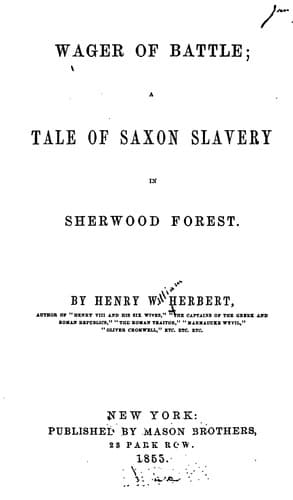
Wager of Battle: A Tale of Saxon Slavery in Sherwood ForestHerbert, Henry William
History
Wager of Battle: A Tale of Saxon Slavery in Sherwood Forest
Herbert, Henry William
Anglo-Saxons -- Fiction; Great Britain -- History -- Norman period, 1066-1154 -- Fiction; Sherwood Forest (England) -- Fiction
Then Geoffrey Fitz Peter rose and opened the case by stating that
they should prove the person at the bar to be a serf, known as
"Eadwulf the Red," who has escaped from the manor of his lord at
Waltheofstow, in Sherwood Forest, against his lord's will, on the
13th day of July last passed--that he had killed a deer, with a
cross-bolt, on that same day, in the forest between Thurgoland and
Bolterstone--and afterward murdered the bailiff of the manor of
Waltheofstow, as aforesaid, with a similar weapon, at or near the same
place, which weapons would be produced in court, and identified by
comparison with corresponding weapons, and the arbalast to which they
belong, found in the possession of the prisoner, when taken at
Kentmere in Westmoreland--that he had been hunted hot-foot, with
bloodhounds, through the forest, and across the moors to the Lancaster
sands, when he had escaped only by the aid of the fatal and furious
tide which had overwhelmed the pursuing horsemen--that he had been
seen to land on the shore of Westmoreland, by a party of the pursuers,
who had escaped the flood-tide by skirting the coastline, and had been
traced, foot by foot, by report of the natives of the country, who had
heard of the arrival of a fugitive serf in the neighborhood, until he
was captured in a cottage beside Kentmere, on the 10th day of October
of this present year. And to prove this, he called Sir Foulke d'Oilly.
He, being sworn, testified that he knew, and had often seen, his serf
"Eadwulf the Red," on the manor of Waltheofstow, and fully believed
the person at the bar to be the man in question. He had joined the
pursuers of the fugitive on the day after the catastrophe of the
sands, had been engaged in tracing him to the cottage on Kentmere, and
fully believed the person captured to be the same who was traced
upward from the sands. Positively identified and swore to the person
at the bar, as the man captured on the 10th day of October, and to the
crossbow and bolts produced in court, and branded with the name
"Kenric," as taken in his possession.
Being cross-examined--he could not swear positively to any personal
recollection of the features of "Eadwulf the Red," or that the person
at the bar _was_ the man, or _resembled_ the man, in question.
Believed him to be the man Eadwulf, because it was the general
impression of his people that he was so.
Thomas de Curthose said--"This, my lords, is mere hearsay, and stands
for naught." And Sir Ranulf de Glanville bowed his head, and
replied--"Merely for naught."
Then Sir Foulke d'Oilly, being asked how, when he assumed this
person's name to be Eadwulf, he ascribed to him the ownership of
weapons stamped "Kenric," he replied, that "Kenric" was a name
prepared aforehand, to avert suspicion, and assumed by Eadwulf, so to
avoid suspicion.
Public-domain text, read in full here on John Shaqi.
Reviews
Reviews
No reviews yet
Be the first to share your thoughts on this work.
Elsewhere in the archive
Join the Discussion
Join the discussion
Sign in to leave a comment or review.
Sign InorCreate an account