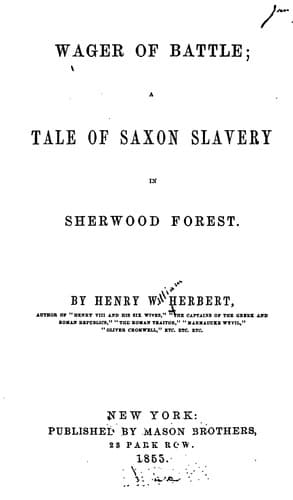
Wager of Battle: A Tale of Saxon Slavery in Sherwood ForestHerbert, Henry William
History
Wager of Battle: A Tale of Saxon Slavery in Sherwood Forest
Herbert, Henry William
Anglo-Saxons -- Fiction; Great Britain -- History -- Norman period, 1066-1154 -- Fiction; Sherwood Forest (England) -- Fiction
Being asked where he showed that Eadwulf had assumed such other name,
or that the name "Kenric" had ever been assumed by one truly named
"Eadwulf," he replied, that "It was probable."
Thomas de Curthose said--"That is mere conjecture."
And, again, the justiciary assented.
CHAPTER XXIV.
THE ACQUITTAL.
No ceremony that to great ones 'longs,
Not the king's crown, nor the deputed sword,
The marshal's truncheon, nor the judge's robe,
Become them with one half so good a grace
As "justice" does.
MEASURE FOR MEASURE.
Then was called Ralph Brito.
He, being sworn, deposed thus--Is a man-at-arms of Sir Foulke d'Oilly;
has served him these twenty years and over, in France, in Wales, and
in Ireland. Has dwelt the last ten years, until this year now current,
at Sir Foulke's castle of Fenton in the Forest; since the decease of
Sir Philip de Morville, has been one of the garrison of Waltheofstow.
Knows Eadwulf the Red perfectly well--as well as his own brother. Has
known him these ten years back, when he was gross thrall to Sir Philip
de Morville. Has seen him since the death of Sir Philip. Has seen him
daily, since he made one of the garrison of Waltheofstow, until the
twelfth day of September last, when he saw him for the last time,
until he was taken in the cottage on Kentmere. The person at the bar
is the man. The person at the bar is Eadwulf the Red, and is also the
man who was taken at the cottage. They are the same. Did not follow
the prisoner with the bloodhounds; came up, with my lord, the day
after the accident on the sands. Was engaged in the pursuit till he
was taken; was present at the arrest. The weapons in court were taken
in the prisoner's house; took them down himself, from above the
mantle-piece. The prisoner admitted them to be his weapons.
Matthew Gourlay, cross-examining, asked him--"You swear, certainly,
that the man at the bar is _he_, known, in the time of Sir Philip
de Morville, as Eadwulf the Red?"
"I do."
"Of your own knowledge?"
"Of my own knowledge."
"Why was he called the Red?"
"Because he _was_ red."
"What part of him?"
"His hair and beard."
"Of what color are your own hair and beard?"
"Red."
It so happened that the close-curled hair and the beard, knotted like
the wool of a poodle dog, of this man, were of the brightest and most
fiery hue of which the human hair is susceptible; while that of Kenric
was of a deep, glossy auburn, falling in loose waves from a broad fair
forehead.
"And what color is the person's at the bar?"
"Why, reddish, I suppose," said Ralph Brito, sullenly.
"About the same color with your own, ha? Well, you may go down," he
said, satisfied that he had somewhat damaged the evidence, even of
this positive perjurer.
Public-domain text, read in full here on John Shaqi.
Reviews
Reviews
No reviews yet
Be the first to share your thoughts on this work.
Elsewhere in the archive
Join the Discussion
Join the discussion
Sign in to leave a comment or review.
Sign InorCreate an account