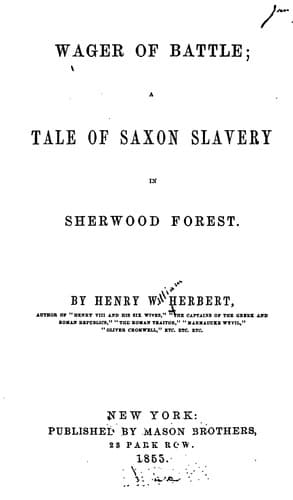
Wager of Battle: A Tale of Saxon Slavery in Sherwood ForestHerbert, Henry William
History
Wager of Battle: A Tale of Saxon Slavery in Sherwood Forest
Herbert, Henry William
Anglo-Saxons -- Fiction; Great Britain -- History -- Norman period, 1066-1154 -- Fiction; Sherwood Forest (England) -- Fiction
Andrew of Spyinghow was then called, and, being sworn, testified, that
"he is the brother of Ralph Wetheral, the bailiff of Waltheofstow, who
was found dead in the forest of Sherwood, on the 13th day of September
last passed; and of Hugonet the Black, seneschal of Waltheofstow, as
aforesaid, who was lost in the sands of Lancaster, on the 17th day of
the said month. He and his brothers were known as the three spears of
Spyinghow. He knew the serf, spoken of as Eadwulf the Red, as well as
he knew his own face in the mirror. Had known him any time the last
ten years, as serf, both to Sir Philip de Morville, and to his own
lord, Sir Foulke d'Oilly. Had seen him last on the night of September
the 12th, in the castle court at Waltheofstow; but had tracked him
thence with bloodhounds to the verge of Borland Forest; had followed
him by hue and cry across the moors to the sands of Morecambe Bay; had
seen the fugitive crossing the bay; had seen him land on the
Westmoreland shore, nor ever had lost the track of him, until he saw
him taken in the cottage at Kentmere. The prisoner at the bar is the
man." The witness then proceeded at length to describe the discovery
of the slain stag, and the murdered bailiff, the manner of their
deaths, the weapons found in the mortal wounds both of the beast and
the man, and of the taking up of the scent of the fugitive from the
spot where the double killing had taken place, by the bloodhounds.
Here Thomas de Curthose said--"This is a case we are trying, in this
court of common pleas, of neifty, _de nativo habendo_; not a case
of deer-slaying, in a forest court, or of murder, in a criminal court.
Therefore, this evidence, as irrelevant, and tending to prejudice the
jury against the prisoner, should be ruled out."
Geoffrey Fitz Peter said; "This testimony goeth only to prove the
weapons, which were carried and used by the fugitive, be he who he
may, at that place and that time stated, to be the same with those
found in possession of the person at the bar, and owned by him to be
his property. And this testimony we propose to use, in order to show
that the person at the bar was actually at the place at the time
stated as aforesaid, and is the very fugitive in question; not that he
is the killer of the deer, or the murderer of the man, which it is not
in the province of this court, or in our purpose to examine."
Sir Ranulf de Glanville said--"To prove the identity of the person at
the bar with the alleged fugitive, this evidence standeth good, but
not otherwise."
Public-domain text, read in full here on John Shaqi.
Reviews
Reviews
No reviews yet
Be the first to share your thoughts on this work.
Elsewhere in the archive
Join the Discussion
Join the discussion
Sign in to leave a comment or review.
Sign InorCreate an account