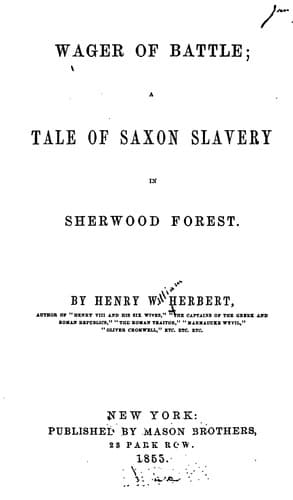
Wager of Battle: A Tale of Saxon Slavery in Sherwood ForestHerbert, Henry William
History
Wager of Battle: A Tale of Saxon Slavery in Sherwood Forest
Herbert, Henry William
Anglo-Saxons -- Fiction; Great Britain -- History -- Norman period, 1066-1154 -- Fiction; Sherwood Forest (England) -- Fiction
In it there were no gayly decorated lists, flaunting with tapestries
and glittering with emblazoned shields; no gorgeous galleries crowded
with ladies, a galaxy of beauty in its proudest adornment; no banners,
no heralds in their armorial tabards, no spirit-thrilling shouts, no
soul-inspiring music, only a solitary trumpet for the signals; but,
instead of this, a bare space strewed with sawdust, and surrounded
with naked piles, rudely-fashioned with the saw and hatchet; an
entrance at either end, guarded by men-at-arms, and at one angle, just
without the barrier, a huge black-gibbet, a block, with the broad ax,
the dissecting-knife, and all the hideous paraphernalia of the
headsman's trade, and himself a dark and sordid figure, masked and
clad in buff of bull's hide, speckled and splashed with the gory
stains of many a previous slaughter, leaning against the gallows. The
seats for the spectators--for, like all other tragedies of awful and
engrossing interest, a judicial combat never lacked spectators--were
strewed, in lieu of silken-hangings and sendal-cushions, with plain
black serge; and the spectators themselves, in lieu of the gay,
holiday vestments in which they were wont to attend the gay and gentle
passages of arms, wore only their every-day attire, except where some
friend or favorer of the appellant or appellee, affected to wear
white, in token of trust in his innocence, with a belt or kerchief of
the colors worn by the favored party.
Amid all this gloom and horror, the only relieving point was the
superb surcoats and armor of the constable and mareschal, and the
resplendent tabard of the king-at-arms, who sat on their caparisoned
horses without the lists, backed by a powerful body of men-at-arms and
archers, as judges of the field, and doomsters of the vanquished in
that strife which must end in death and infamy to one or the other of
the combatants.
From an early hour, long before the first gray dawn of day, all the
seats, save those preserved for certain distinguished personages, had
been occupied by a well-dressed crowd; all the avenues to the place
were filled, choked, to overflowing; the roofs, the balconies, the
windows of every house that commanded a view of the lists, the
steeples of the neighboring churches, the battlements and the
bartizans of the gray old castle, already gray and old in the second
century of Norman dominion, were crowded with eager and excited
multitudes--so great was the interest created by the tidings of that
awful combat, and the repute for prowess of the knights who were
pitted in it to meet and part no more, until one should go down
forever.
And now the shadow was cast upon the dial, close to the fated hour of
ten, from the clear winter sun, to borrow the words of the greatest
modern poet--
"Which rose upon that heavy day,
And mocked it with its steadiest ray."
Public-domain text, read in full here on John Shaqi.
Reviews
Reviews
No reviews yet
Be the first to share your thoughts on this work.
Elsewhere in the archive
Join the Discussion
Join the discussion
Sign in to leave a comment or review.
Sign InorCreate an account