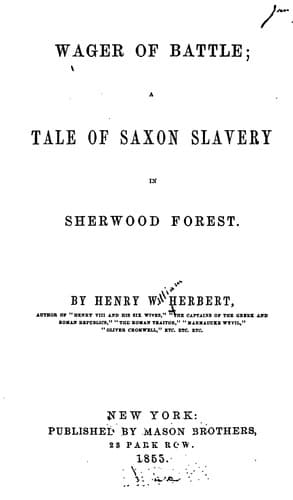
Wager of Battle: A Tale of Saxon Slavery in Sherwood ForestHerbert, Henry William
History
Wager of Battle: A Tale of Saxon Slavery in Sherwood Forest
Herbert, Henry William
Anglo-Saxons -- Fiction; Great Britain -- History -- Norman period, 1066-1154 -- Fiction; Sherwood Forest (England) -- Fiction
The castle gates rolled open on their hinges, grating harsh thunder;
and forth came a proud procession, the high-justiciary and his five
associate judges, with their guard of halberdiers, and the various
high officers of the court, among these the sheriff, whose anxious
and interested looks, and, yet more, whose pale and lovely daughter,
hanging on his arm, so firm and yet so wan and woe-begone, excited
general sympathy.
And when it was whispered through the multitude, as it was almost
instantaneously--for such things travel as by instinct--that she was
the betrothed of the young appellant, and that, to win her with his
spurs of gold, he had assumed this terrible emprize, all other
excitement was swallowed up in the interest created by the cold and
almost stern expression of her lovely features, and her brave
demeanor.
And more ladies than one whispered in the ears of those who were
dearest to them; "If he be vanquished, she will not survive him!"
And many a manly voice, shaken in a little of its firmness, made
reply;
"He may be slain, but he can not be vanquished."
Scarcely had the members of the Court been seated, with those of the
higher gentry and nobility, who had waited to follow in their suit,
when from the tower of a neighboring Cistercian house, the clock
struck ten; and, now, as in that doleful death-scene in Parisina;
"The convent-bells are ringing,
But mournfully and slow:
In the gray square turret swinging,
With a deep sound, to and fro,
Heavily to the heart they go.
Hark! the hymn is singing--
The song for the dead below,
Or the living who shortly shall be so;
For a departing being's soul
The death-hymn peals, and the hollow bells knoll."
While those bells were yet tolling, and before the echoes of the last
stroke of ten had died away, two barefooted friars entered the lists,
one at either end, each carrying a Bible and a crucifix; and at the
same moment the two champions were seen advancing, each to his own end
of the lists, accompanied by his sureties or god-fathers, all armed in
complete suits of chain-mail; Sir Aradas as appellant, entering at the
east, Sir Foulke at the left end of the inclosure.
Here they were met each by one of the friars, the constable and
mareschal riding close up to the barriers, to hear the plighting of
their oaths.
And at this moment, the eyes of all the multitude were riveted on the
forms of the two adversaries, and every judgment was on the stretch to
frame auguries of the issue, from the thews, the sinews, and the
demeanor, of the two champions.
Public-domain text, read in full here on John Shaqi.
Reviews
Reviews
No reviews yet
Be the first to share your thoughts on this work.
Elsewhere in the archive
Join the Discussion
Join the discussion
Sign in to leave a comment or review.
Sign InorCreate an account