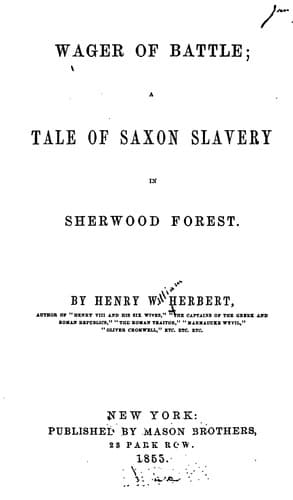
Wager of Battle: A Tale of Saxon Slavery in Sherwood ForestHerbert, Henry William
History
Wager of Battle: A Tale of Saxon Slavery in Sherwood Forest
Herbert, Henry William
Anglo-Saxons -- Fiction; Great Britain -- History -- Norman period, 1066-1154 -- Fiction; Sherwood Forest (England) -- Fiction
Their defensive arms were nearly similar. Each wore a habergeon, or
closely-fitting shirt of linked mail, with mail sleeves, mail hose,
poldron, genouillieres, and shoes of plated splints of steel; and
flat-topped helmets, with avantailles and beavers. But the neck of Sir
Foulke d'Oilly was defended by the new-fashioned gorget of steel
plates, while Aradas adhered to the old mail-hood or tippet, hooked on
to the lower rim of his beaver. And it was observed that while d'Oilly
wore his small heater-shaped shield on his left arm, De Ratcliffe threw
his over his shoulder, suspended from the chain which held it about his
neck, so as to leave both his arms free to wield his mighty war-sword.
Beyond this, it was only noted that in the casque of Sir Aradas was a
lady's glove, and on his left arm an azure scarf, fringed with gold,
such as the pale girl on the seneschal's arm wore, over her snow-white
cymar, crossing her left shoulder and the region of her heart.
And now the godfathers left the lists, and none remained within them
save the two champions facing each other, like two pillars of steel, as
solid and as motionless, until the word should be given to set on, and
the two barefooted friars, crouching on their knees in the angles of
the lists, muttering their orisons before the crucifixes, which they
held close before their eyes, as if to shut out every untoward sight
which might mar their meditations.
Then a single trumpet was blown. A sharp, stern, warning blast. And a
herald made proclamation;
"Oyez! oyez! oyez! This is _champ clos_, for the judgment of God.
Therefore, beware all men, to give no aid or comfort to either
combatant, by word, deed, sign, or token, on pain of infamy and
mutilation."
Then the constable rose in his stirrups, and cried aloud--
"Let them go!"
And the trumpet sounded.
"Let them go!"
And, again, the trumpet sounded.
"Let them go! Do your duty!"
And the earl mareschal answered,
"And may God defend the right!"
And, the third time, the trumpet sounded, short and direful as the
blast of doom; and at that deadly summons, with brandished blades, both
champions started forward; but the first bound of Sir Aradas carried
him across two thirds of the space, and his sword fell like a
thunderbolt on the casque of his antagonist, and bent him almost to his
knee. But that was no strife to be ended at a blow; and they closed,
foot to foot, dealing at each other sweeping blows, which could not be
parried, and could scarcely be avoided, but which were warded off by
their armor of proof.
It was soon observed that Sir Foulke d'Oilly's blows fell with far the
weightier dint, and that, when they took effect, it was all his lighter
adversary could do to bear up against them. But, on the other hand, it
was seen that, by his wonderful agility, and the lithe motions of his
supple and elastic frame, Sir Aradas avoided more blows than he
received, and that each stroke missed by his enemy told almost as much
against him as a wound.
Public-domain text, read in full here on John Shaqi.
Reviews
Reviews
No reviews yet
Be the first to share your thoughts on this work.
Elsewhere in the archive
Join the Discussion
Join the discussion
Sign in to leave a comment or review.
Sign InorCreate an account