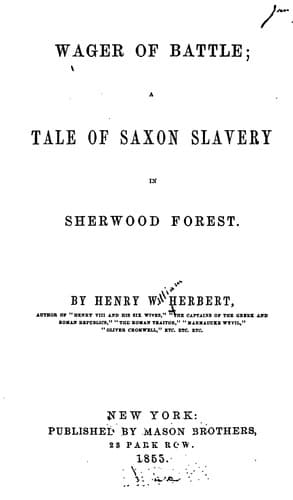
Wager of Battle: A Tale of Saxon Slavery in Sherwood ForestHerbert, Henry William
History
Wager of Battle: A Tale of Saxon Slavery in Sherwood Forest
Herbert, Henry William
Anglo-Saxons -- Fiction; Great Britain -- History -- Norman period, 1066-1154 -- Fiction; Sherwood Forest (England) -- Fiction
At the end of half an hour, no material advantage had been gained; the
mail of either champion was broken in many places, and the blood
flowed, of both, from more wounds than one; that of Aradas the more
freely.
But as they paused, perforce, to snatch a moment's breath, it was clear
that Sir Aradas was the fresher and less fatigued of the two; while Sir
Foulke was evidently short of wind, and hard pressed.
It was not the young man's game to give his enemy time--so, before half
a minute had passed, he set on him again, with the same fiery vigor and
energy as before. His opponent, however, saw that the long play was
telling against him, and it appeared that he was determined to bring
the conflict to a close by sheer force.
One great stride he made forward, measuring his distance accurately
with his eye, and making hand and foot keep time exactly, as he swung
his massive blade in a full circle round his head, and delivered the
sweeping blow, at its mightiest impetus, on the right side of his
enemy's casque.
Like a thunderbolt it fell; and, beneath its sway, the baçinet,
cerveilliere, and avantaille of Aradas gave way, shattered like an
egg-shell. He stood utterly unhelmed, save that the beaver and the base
of the casque, protecting the nape of his neck and his lower jaw, held
firm, and supported the mailed hood of linked steel rings, which
defended his neck to the shoulder. All else was bare, and exposed to
the first blow of his now triumphant antagonist.
The fight seemed ended by that single blow; and, despite the injunction
of the herald, a general groan burst from the assembly. Guendolen
covered her face with her hands for a second, but then looked up again,
with a wild and frenzied eye, compelled to gaze, to the last, on that
terribly fascinating scene.
But then was it shown what might there is in activity, what resistless
power in quickness. For, leaping and bounding round the heavy giant,
like a sword-player, letting him waste his every blow on the empty air
or in the impassive sawdust, Aradas plied his sword like a thrasher's
flail, dealing every blow at his neck and the lacings of his casque,
till fastening after fastening broke, and it was clear that d'Oilly,
too, would be unhelmed in a few more moments.
The excitement of the people was ungovernable; they danced in their
seats, they shouted, they roared. No heralds, no pursuivants, no
men-at-arms, could control them. The soul of the people had awakened,
and what could fetter it?
Still, wonderful as they were, the exertions of Aradas, completely
armed in heavy panoply, were too mighty to last. The thing must be
finished. Down came the trenchant blade with a circling sweep, full on
the jointed-plates of d'Oilly's new-fangled gorget. Rivet after rivet,
plate after plate, gave way with a rending crash; his helmet rolled on
the ground. He stood bare-headed, bare-throated, unarmed to the
shoulders.
Public-domain text, read in full here on John Shaqi.
Reviews
Reviews
No reviews yet
Be the first to share your thoughts on this work.
Elsewhere in the archive
Join the Discussion
Join the discussion
Sign in to leave a comment or review.
Sign InorCreate an account