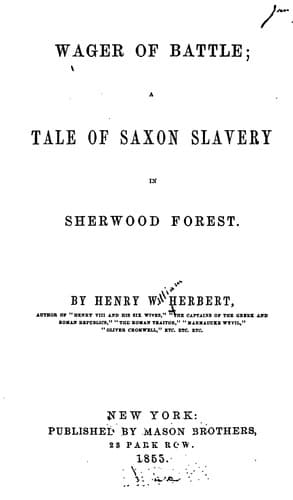
Wager of Battle: A Tale of Saxon Slavery in Sherwood ForestHerbert, Henry William
History
Wager of Battle: A Tale of Saxon Slavery in Sherwood Forest
Herbert, Henry William
Anglo-Saxons -- Fiction; Great Britain -- History -- Norman period, 1066-1154 -- Fiction; Sherwood Forest (England) -- Fiction
Sir Yvo de Taillebois, with twenty or thirty of the greatest barons
of the north country, his cotemporaries, and many of them his
brothers-in-arms, and fellows at the council-table of their puissant
Norman monarch, whom they admitted only to be first baron of the
English barons, _primus inter pares_, brought up the rear of the
procession, while yet behind them filed a long band of spears and
pennoncelles, and again after these a countless multitude, from all
the country side, rejoicing and exulting, to form a portion of the
pageant which added so much to the customary pleasures of the Maying.
Thus, for miles, they swept onward through the pleasant meadow-land,
tufted and gemmed with unnumbered flowers, between tall hedges white
with the many-blossomed May, and overrun with flaunting clusters of
the delicious woodbine.
Once and again they were met by troops of country girls scattering
flowers, and as often rode beneath triumphal arches, deftly framed of
green leaves and gay wild-flowers by rustic hands, in token of the
heart's gratitude, until they reached the shores of the blue lake,
where Sir Yvo's yacht awaited them, convoyed by every barque and boat
that could be pressed into the service from all the neighboring meres
and lakelets of the county.
The wind blew fair and soft, and swelled the sails of cloth of silver,
and waved the long azure pennants forward, as omens of happy days
ahead; and smoothly over the rippling waters, to the sound of the soft
bridal music, galleys and horse-boats, barques and barges, careered in
fair procession, while the great multitude, afoot, rushed, like an
entering tide, through the horse-roads and lanes around the head of
the lake, eager to share the wedding-feast and the wedding dance, at
least, if not to witness the nuptial ceremonial.
At Bowness they took horse again, and escorted by the bailiff and
burghers of Kendall, proceeded, at an increased pace, to the splendid
Abbey Church, dim with the religious light which streamed through its
deeply tinted window-panes, and was yet further obscured by the thick
clouds from the tossed chalices of incense, through which swelled,
like an angel's choir, the pure chant of girls and children, and the
deep diapason of the mighty organ.
The nuptial ceremony was followed by a feast fit for kings, served up
in the grand hall of Kendal Castle, wherein, before the Norman
conquest, the proud Saxon Earls, Morcar and Edwin, maternal ancestors
of the fair bride, had banqueted and rioted in state, and where, as
tradition related, they had held revel for the last time on the eve of
their departure for the fatal field of Hastings, fatal to Saxon
liberty, but harbinger of a prouder era, and first cause and creatrix
of a nobler race, to rule in Merrie England.
Public-domain text, read in full here on John Shaqi.
Reviews
Reviews
No reviews yet
Be the first to share your thoughts on this work.
Elsewhere in the archive
Join the Discussion
Join the discussion
Sign in to leave a comment or review.
Sign InorCreate an account