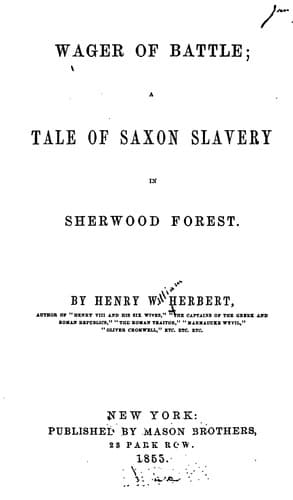
Wager of Battle: A Tale of Saxon Slavery in Sherwood ForestHerbert, Henry William
History
Wager of Battle: A Tale of Saxon Slavery in Sherwood Forest
Herbert, Henry William
Anglo-Saxons -- Fiction; Great Britain -- History -- Norman period, 1066-1154 -- Fiction; Sherwood Forest (England) -- Fiction
It needs not, here, to dwell on the strange dainties, the now
long-disused and unaccustomed viands and beverages of those old days,
more than on the romantic feudal usages and abstruse ceremonials of
the day; suffice it that, to their palates, heronshaw, egret and
peacock, venison and boar's-meat, and chines of the wild bull, were no
less dainty than the choicest of our modern luxuries to the beaux and
belles of the nineteenth century; and that hypocras and pigment, morat
and mead and clary, made the pulses burn and the cheeks mantle as
blythely and as brightly as Champagne or Burgundy. The ball, for the
nobles in the castle-hall, for the commons on the castle-green,
followed the feast; but not till the stocking had been thrown, and the
curtain drawn, and the beautiful bride fairly bedded, was the nuptial
ceremony esteemed fully ended, which gave the lovely Guendolen, for
weal and not for woe, to the brave and faithful Aradas de Ratcliffe.
The raptures of lovers are not to be described; and if the pen of the
ready-writer may gain inspiration to delineate the workings of strong
mental passions, of intense moral or physical excitements, to depict
stormy wrath, the agonies of hope deferred, the slow-consuming pangs
of hopeless regret, there is one thing that must ever defy his powers
of representation--the calm enjoyment of every-day domestic happiness;
the easy and unvarying pleasures of contentment; the placid routine of
hourly duties, hourly delights, hourly labors, hourly affections; and
that soft intermixture of small cares and passing sorrows, with great
blessings tasted, and great gratitudes due, which make up the sum of
the most innocent and blessed human life.
And such was the life of Sir Aradas and the fair Guendolen de
Ratcliffe, until, to borrow the quaint phrase of the narrator of those
incomparable tales of the Thousand and One Nights, "they were visited
by the terminator of delights, and the separator of companions.
Extolled be the perfection of the Living, who dieth not!"
Sir Yvo de Taillebois lived long enough to see his child's children
gathered to his knee; to prognosticate, in their promise, fresh honors
to his high-born race; but not so long as to outlive his intellect,
his powers to advise, console, enjoy, and, above all, to trust in God.
Full of years and full of honors, he was gathered to his fathers in
the ripeness of his time, and he sleeps in a quiet churchyard in his
native valley, where a green oak-tree shades his ashes, and the
ever-vocal music of the rippling Kent sings his sweet, natural
requiem.
Public-domain text, read in full here on John Shaqi.
Reviews
Reviews
No reviews yet
Be the first to share your thoughts on this work.
Elsewhere in the archive
Join the Discussion
Join the discussion
Sign in to leave a comment or review.
Sign InorCreate an account