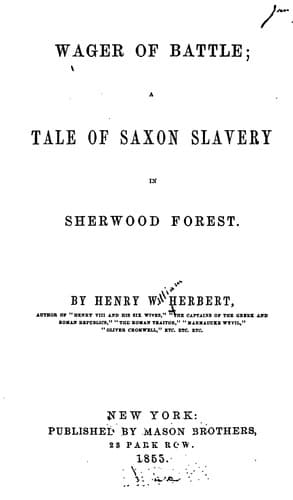
Wager of Battle: A Tale of Saxon Slavery in Sherwood Forest — John Shaqi
Wager of Battle: A Tale of Saxon Slavery in Sherwood ForestHerbert, Henry William
History
Wager of Battle: A Tale of Saxon Slavery in Sherwood Forest
Herbert, Henry William
Anglo-Saxons -- Fiction; Great Britain -- History -- Norman period, 1066-1154 -- Fiction; Sherwood Forest (England) -- Fiction
It is hoped, however, that--notwithstanding this similarity, and the
fact that in both works the interest turns in some degree on the
contrast between the manners of the Saxon and Norman inhabitants of the
isle, and the state of things preceding the fusion of the two races
into one--notwithstanding, also, that in each a portion of the effect
depends on the introduction of a judicial combat, or "Wager of
Battle"--the resemblance will be found to be external and incidental
only, and that, neither in matter, manner, nor subject, is there any
real similarity between the books, much less any imitation or absurd
attempt, on my part, at rivalry with that which is admitted to be
incomparable. It will be seen, at once, by those who have the patience
to peruse the following pages, that I have aimed at something more than
a mere delineation of outward habits, customs, and details of martial
or pacific life; that I have entered largely into the condition of
classes, the peculiar institution of Serfdom, or White Slavery, as it
existed among our own ancestors--that portion of whom, from which our
blood is in the largest degree descended, being the servile population
of the island--in the twelfth century, and the steps which led to its
gradual abolition.
In doing this, I have been unavoidably led into the necessity of
dealing with the ancient jurisprudence of our race, the common law of
the land, the institution of Trial by Jury, and that singular feature
in our old judicial system, the reference of cases to the direct
decision of the Almighty by Wager of Battle, or, as it was also called,
"the Judgment of God."
I will here merely observe that, while the gist of my tale lies in the
adventures and escape of a fugitive Saxon Slave from the tyranny of his
Norman Lord, my work contains no reference to the peculiar institution
of any portion of this country, nor conceals any oblique insinuation
against, or covert attack upon, any part of the inhabitants of the
Continent, or any interest guaranteed to them by the Constitution.
Nevertheless, I would recommend no person to open a page of this
volume, who is prepared to deny that slavery _per se_ is an evil and a
wrong, and its effects deteriorating to all who are influenced by its
contact, governors alike and governed, since they will find nothing
agreeable, but much adverse to their way of thinking.
That it is an evil and a wrong, in itself, and a source of serious
detriment to all parties concerned, I can not but believe; and that,
like all other wrongs and evils, it will in the end, by God's wisdom,
be provided for and pass away, without violence or greater indirect
wrong and evil, I both believe and hope.
Public-domain text, read in full here on John Shaqi.
Reviews
Reviews
No reviews yet
Be the first to share your thoughts on this work.
Join the Discussion
Join the discussion
Sign in to leave a comment or review.
Sign InorCreate an account