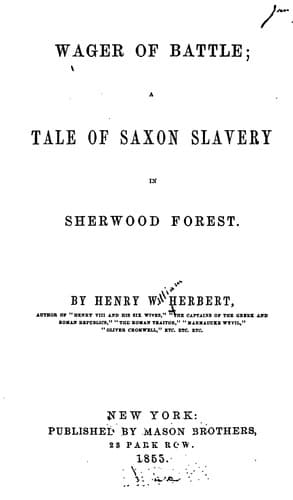
Wager of Battle: A Tale of Saxon Slavery in Sherwood ForestHerbert, Henry William
History
Wager of Battle: A Tale of Saxon Slavery in Sherwood Forest
Herbert, Henry William
Anglo-Saxons -- Fiction; Great Britain -- History -- Norman period, 1066-1154 -- Fiction; Sherwood Forest (England) -- Fiction
Still, although well-nigh a century had elapsed since the Norman
Conquest, and the heir of the Conqueror in the fourth generation was
sitting on the throne which that great and politic prince won on the
fatal day of Hastings, their condition had not become habitual or easy
to those, at least, who had been reduced to slavery from freedom, by
the consequences of that disastrous battle. And such was the condition
of the family whence sprang Kenric and Edith. The Saxon thane,
Waltheof, whose name and that of his abode had descended to the Norman
fortalice which had arisen from the ashes of his less aspiring manor,
had resisted the Norman invaders so long, with such inveterate and
stubborn valor, and, through the devotion of his tenants and
followers, with such cost of life, that when he fell in fight, and his
possessions were granted to his slayer, all the dwellers on his lands
were involved in the common ruin.
To the serfs of the soil, who had been serfs before the conquest, it
mattered but little. The slave to the Saxon was but changed into the
slave of the Norman, and did not perhaps find in him a crueller,
though he might a haughtier and more overbearing master. But to the
freeman, the doom which consigned him to the fetters of the Norman,
which converted him from the owner into the serf of the soil, was
second only, if second, to the bitterness of death. And such had been
the doom of the grandfather of Kenric and Eadwulf.
Their mother herself had been born free, not far from the hovel in
which she still dwelt a slave, though she was but an infant when the
hurricane of war and ruin swept over the green oaks of Sherwood, and
had no memory of the time when she was not the thrall of a foreign
lord. Her father, Wulfred, was the largest tenant under Waltheof,
himself a franklin, or small landholder, and of blood as noble, and
station more elevated than that of one half the adventurers who had
flocked to the banner of William the invader. With his landlord and
friend, he had fought to the last, not at Hastings only, but in every
bloody ineffectual rising, until the last spark of Saxon liberty was
trampled out under the iron hoofs of the Norman war-horse; but, less
happy than Waltheof, he had survived to find himself a slave, and the
father of slaves, tilling for a cruel foreign conqueror the land which
had been his own and his father's, and his father's father's, but in
which he and his heirs should have no heritage for evermore, beyond
the six-foot measure which should be meted to them every one, for his
long home.
And the memory of these things had not yet passed away, nor the
bitterness of the iron departed from the children, which had then
entered into the soul of the parent.
Public-domain text, read in full here on John Shaqi.
Reviews
Reviews
No reviews yet
Be the first to share your thoughts on this work.
Elsewhere in the archive
Join the Discussion
Join the discussion
Sign in to leave a comment or review.
Sign InorCreate an account