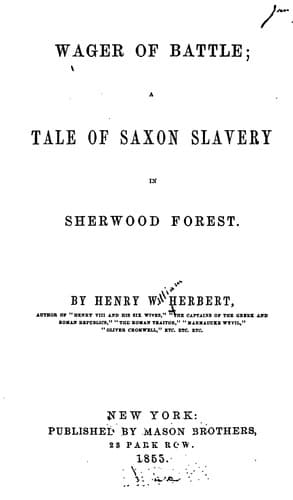
Wager of Battle: A Tale of Saxon Slavery in Sherwood ForestHerbert, Henry William
History
Wager of Battle: A Tale of Saxon Slavery in Sherwood Forest
Herbert, Henry William
Anglo-Saxons -- Fiction; Great Britain -- History -- Norman period, 1066-1154 -- Fiction; Sherwood Forest (England) -- Fiction
Up to that time, she had regarded them, certainly, on the whole, as a
slow, as a somewhat stolid, impassive, and unimpassioned race, less
mercurial than her own impetuous, impulsive kindred, and far less
liable to strong emotions or keen perceptions, whether of pain or
pleasure. The girlish liveliness and gentleness, and even the untaught
graces of Edith had, at the first, attracted her; and, as she was
thrown a good deal into contact with her, from the fact of her
constant attendance on the chambers she occupied, she had become much
interested in her, regarding her as one of the happiest, most artless,
and innocent little girls she had ever met--one, she imagined, on whom
no shadow of grief had ever fallen, and whose humble lot was one of
actual contentment, if not of positive enjoyment.
Nor, hitherto, insomuch as actual realities were concerned, was
Guendolen much in error. Sir Philip de Morville, as has been stated
already, was, according to the times and their tenor, a good and
considerate lord. His bailiff was a well-intentioned, strict man,
intent on having his master's work done to the last straw, but beyond
that neither an oppressor nor a tyrant. Kenric, her distant kinsman
and betrothed, was confessedly the best man and most favored servant
in the quarter; and his mother, who had grown old in the service of
Sir Philip's father, whom she had nursed with simple skill through the
effects of many a mimic battle in the lists, or real though scarce
more dangerous fray, now superannuated, reigned as much the mistress
of her son's hearth as though she had been a free woman, and the cot
in which she dwelt her freehold.
Edith herself was the first bower-maiden of the castle, and, safe
under the protecting wings of dame Ulrica, the housewife, defied the
impertinence of forward pages, the importunate gallantry of esquires,
and was cheerfully acknowledged as the best and prettiest lass of the
lot, by the old gray-haired seneschal, in his black velvet suit and
gold chain of office.
Really, therefore, none of her own immediate family had known any
actual wants, or suffered any material hardships or sorrows, through
their condition, up to the period at which my tale commences. Their
greatest care, perhaps, had arisen from the temper, surly, rude,
insolent, and provocative, of Eadwulf the Red, Kenric's brother, who
had already, by misconduct, and even actual crime, according to the
Norman code, subjected himself to severe penalties, and been reduced,
in default of harsher treatment, to the condition of a mere slave, a
chattel, saleable like an ox or ass, at the pleasure of their lord.
This, both in its actual sense, as keeping them in constant
apprehension of what further distress Eadwulf's future misconduct
might bring upon them, and in its moral bearing, as holding them
constantly reminded of their own servile condition, had been, thus
far, their prime grief and cause of complaint, had they been persons
given to complain.
Public-domain text, read in full here on John Shaqi.
Reviews
Reviews
No reviews yet
Be the first to share your thoughts on this work.
Elsewhere in the archive
Join the Discussion
Join the discussion
Sign in to leave a comment or review.
Sign InorCreate an account