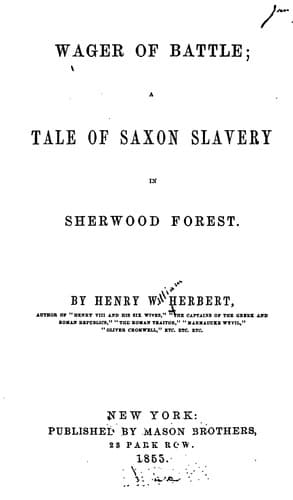
Wager of Battle: A Tale of Saxon Slavery in Sherwood ForestHerbert, Henry William
History
Wager of Battle: A Tale of Saxon Slavery in Sherwood Forest
Herbert, Henry William
Anglo-Saxons -- Fiction; Great Britain -- History -- Norman period, 1066-1154 -- Fiction; Sherwood Forest (England) -- Fiction
His feelings were not those of natural regret at the continuance of
his own unfortunate condition, so much as of unnatural spite at the
alteration in the circumstances of his mother, his brother, and that
brother's beautiful betrothed; and it was but too clear that, whether
he should himself remain free or no, he had been better satisfied that
they should continue in their original condition, rather than that
they should be elevated above himself by any better fortune.
Kenric had in vain striven to soothe his morose and selfish mood, to
cheer his desponding and angry, rather than sorrowful, anticipations--he
had pointed out to him that his own liberation from slavery, and
elevation to the rank and position of a freeman and military tenant of
a fief of land, did not merely render it probable, but actually make
it certain, that Eadwulf also would be a freeman, and at liberty to
join his kindred in a short time in their new home; "for it must be
little, indeed, that you know of my heart," said the brave and manly
peasant, "or of that of Edith, either, if you believe that either of
us could enjoy our own liberty, or feel our own happiness other than
unfinished and incomplete, so long as you, our own and only brother,
remain in slavery and sorrow. Your price is not rated so high, brother
Eadwulf, but that we may easily save enough from our earnings, when
once free to labor for ourselves, within two years at the farthest, to
purchase your freedom too from Sir Philip; and think how easy will be
the labor, and how grateful the earnings, when every day's toil
finished, and every zecchin saved, will bring us a day nearer to a
brother's happy manumission."
"Words!" he replied, doggedly--"mighty fine words, in truth. I marvel
how eloquent we have become, all on the sudden. Your labor _will_
be free, as you say, and your earnings your own; and wondrous little
shall I profit by them. I should think now, since you are so mighty
and powerful with the pretty Lady Guendolen, all for a mere chance
which might have befallen me, or any one, all as well as yourself, you
might have stipulated for my freedom--I had done so I am sure, though
I do not pretend to your fine sympathies and heaven-reaching
notions----"
"And so have lost _their_ freedom!" replied Kenric, shaking his
head, as he waved his hand toward the women; "for that would have been
the end of it. For the rest, I made no stipulations; I only refused
freedom, if it were procurable only by leaving my aged mother and my
betrothed bride in slavery. As it was, I had lost my own liberty, and
not gained theirs, if it had not been for Edith, who won for us all,
what I had lost for one."
"And no one thought of me, or my liberty! I was not worth thinking of,
nor worthy, I trow, to be free."
Public-domain text, read in full here on John Shaqi.
Reviews
Reviews
No reviews yet
Be the first to share your thoughts on this work.
Elsewhere in the archive
Join the Discussion
Join the discussion
Sign in to leave a comment or review.
Sign InorCreate an account