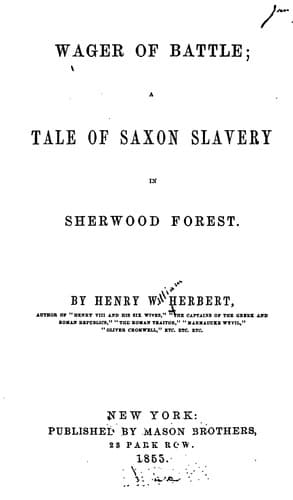
Wager of Battle: A Tale of Saxon Slavery in Sherwood ForestHerbert, Henry William
History
Wager of Battle: A Tale of Saxon Slavery in Sherwood Forest
Herbert, Henry William
Anglo-Saxons -- Fiction; Great Britain -- History -- Norman period, 1066-1154 -- Fiction; Sherwood Forest (England) -- Fiction
"You say well, Eadwulf--you say right well," cried Edith, her fair
face flushing fiery red, and her frame quivering with excitement. "You
are _not_ worthy to be free. There is no freedom, or truth, or love,
or honor, in your heart. Your spirit, like your body, is a serf's, and
one would do dishonor to the soul of a dog, if she likened it to
yours. Had _you_ been offered freedom, you had left all, mother,
brother, and betrothed--had any maiden been so ill-advised as betroth
herself to so heartless a churl--to slavery, and misery, and infamy,
or death, to win your own coveted liberty. Nay! I believe, if they had
been free, and you a serf, you would have betrayed them into slavery,
so that you might be alone free. A man who can not feel and comprehend
such a sacrifice as Kenric made for all of us, is capable of no
sacrifice himself, and is not worthy to be called a man, or to be a
freeman."
Thus passed away that evening, and with the morrow came full
confirmation; and the bold Saxon stood upon his native soil, as free
as the air he breathed; the son, too, of a free mother, and with a
free, fair maiden by his side, soon to be the free wife of a free
Englishman. And none envied them, not one of their fellow-serfs, who
remained still condemned to toil wearily and woefully, until their
life should be over--not one, save Eadwulf, the morose, selfish,
slave-souled brother.
CHAPTER XII.
THE DEPARTURE.
"He mounted himself on a steed so talle,
And her on a pale palfraye,
And slung his bugle about his necke,
And roundly they rode awaye."
THE CHILDE OF ELLE.
The glad days rapidly passed over, and the morning of the tenth day,
as it broke fair and full of promise in the unclouded eastern sky,
looked on a gay and happy cavalcade, in all the gorgeous and
glittering attire of the twelfth century, setting forth in proud
array, half martial and half civil, from the gates of Waltheofstow.
First rode an old esquire, with three pages in bright half armor,
hauberks of chain mail covering their bodies, and baçinets of steel on
their heads, but with their arms and lower limbs undefended, except by
the sleeves of their buff jerkins and their close-fitting hose of
dressed buckskin. Behind these, a stout man-at-arms carried the guidon
with the emblazoned bearings of his leader, followed by twenty mounted
archers, in doublets of Kendal green, with yew bows in their hands,
wood-knives, and four-and-twenty peacock-feathered cloth-yard arrows in
their girdles, and battle-axes at their saddle-bows.
Public-domain text, read in full here on John Shaqi.
Reviews
Reviews
No reviews yet
Be the first to share your thoughts on this work.
Elsewhere in the archive
Join the Discussion
Join the discussion
Sign in to leave a comment or review.
Sign InorCreate an account