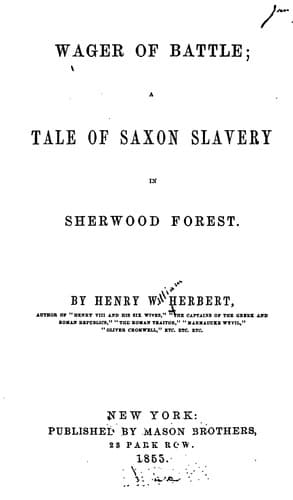
Wager of Battle: A Tale of Saxon Slavery in Sherwood ForestHerbert, Henry William
History
Wager of Battle: A Tale of Saxon Slavery in Sherwood Forest
Herbert, Henry William
Anglo-Saxons -- Fiction; Great Britain -- History -- Norman period, 1066-1154 -- Fiction; Sherwood Forest (England) -- Fiction
Here and there, in the neighborhood of some ancient borough, such as
Doncaster, Pontefract, or Ripon, through which lay their route, they
came upon broad oases of cultivated lands, with smiling farms and
pleasant corn-fields and free English homesteads, stretching along the
fertile valley of some blue brimful river; again, and that more
frequently, they found small forest-hamlets, wood-embosomed, with
their little garths and gardens, clustering about the tower of some
inferior feudal chief, literally set in a frame of verdure.
Sometimes vast tracks of rich and thriftily-cultured meadow-lands,
ever situate in the loveliest places of the shire, pastured by
abundant flocks, and dotted with sleek herds of the already celebrated
short-horns, told where the monks held their peaceful sway, enjoying
the fat of the land; and proclaimed how, in those days at least, the
priesthood of Rome were not the sensual, bigot drones, the ignorant,
oppressive tyrants, whose whereabout can be now easily detected by the
squalid and neglected state of lands and animals and men, whenever
they possess the soil and control the people. Such were the famous
Abbey-stedes of Fountain's and Jorvaulx, then, as now, both for
fertility and beauty, the boast of the West Riding.
Still, notwithstanding these pleasant interchanges of rural with
forest scenery, occurring so often as to destroy all monotony, and to
keep up a delightful anticipation in the mind of the voyager, as to
what sort of view would meet his eye on crossing yon hill-top, or
turning that curvature of the wood-road, by far the greater portion of
their way led them over sandy tracks, meandering like ribbons through
wide glades of greensward, under the broad protecting arms of giant
oaks and elms and beeches, the soft sod no less refreshing to the
tread of the quadrupeds, than was the cool shadow of the twilight
trees delicious to the riders.
Those forests of the olden day were rarely tangled or thicketlike,
unless in marshy levels, where the alder, the willow, and other
water-loving shrubs replaced the monarchs of the wild; or where, in
craggy gullies, down which brawled impetuous the bright hill-streams,
the yew, the holly, and the juniper, mixed with the silvery stems and
quivering verdure of the birches, or the deeper hues of the
broad-leaved witch-elms and hazels, formed dingles fit for fairy
bowers.
For the most part, the huge bolls of the forest-trees stood far apart,
in long sweeping aisles, as regular as if planted by the hand of man,
allowing the grass to grow luxuriantly in the shade, nibbled, by the
vast herds of red and fallow deer and roes, into the softest and most
even sward that ever tempted the foot of high-born beauty.
Public-domain text, read in full here on John Shaqi.
Reviews
Reviews
No reviews yet
Be the first to share your thoughts on this work.
Elsewhere in the archive
Join the Discussion
Join the discussion
Sign in to leave a comment or review.
Sign InorCreate an account