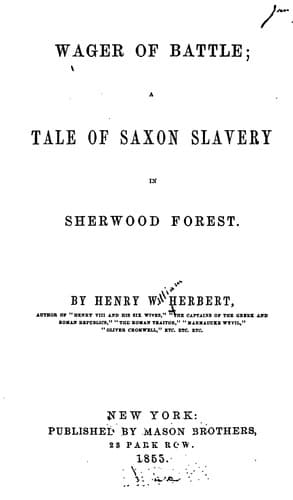
Wager of Battle: A Tale of Saxon Slavery in Sherwood ForestHerbert, Henry William
History
Wager of Battle: A Tale of Saxon Slavery in Sherwood Forest
Herbert, Henry William
Anglo-Saxons -- Fiction; Great Britain -- History -- Norman period, 1066-1154 -- Fiction; Sherwood Forest (England) -- Fiction
In the midst rode Sir Yvo de Taillebois, all armed save his head,
which was covered with a velvet mortier with a long drooping feather,
and wearing a splendid surcoat; and, by his side, on a fleet
Andalusian jennet, in a rich purple habit, furred at the cape and
cuffs, and round the waist, with snow-white swansdown, the fair and
gentle Guendolen, followed by three or four gay girls of Norman birth,
and, happier and fairer than the happiest and fairest, the charming
Saxon beauty, pure-minded and honest Edith. Behind these followed a
train of baggage vans, cumbrous and lumbering concerns, groaning along
heavily on their ill-constructed wheels, and a horse-litter, intended
for the use of the lady, if weary or ill at ease, but at the present
conveying the aged freed-woman, who was departing, now in well-nigh
her ninetieth summer, from the home of her youth, and the graves of
her husband and five goodly sons, departing from the house of bondage,
to a free new home in the far north-west.
The procession was closed by another body of twenty more
horse-archers, led by two armed esquires; and with these rode Kenric,
close shaven, and his short, cropped locks curling beneath a jaunty
blue bonnet, with a heron's feather, wearing doublet and hose of
forest green, with russet doeskin buskins, the silver badge of Sir Yvo
de Taillebois on his arm, and in his hand the freeman's trusty weapon,
the puissant English bow, which did such mighty deeds, and won such
_los_ thereafter, at those immortal fields of Cressy and Poictiers,
and famous Agincourt.
As the procession wound down the long slope of the castle hill, and
through the Saxon quarter, the serfs, who had collected to look on the
show, set up a loud hurrah, the ancient Saxon cry of mirth, of
greeting, or defiance. It was the cry of _caste_, rejoicing at
the elevation of a brother to the true station of a man. But there was
one voice which swelled not the cry; one man, who turned sullenly
away, unable to bear the sight of another's joy, turned away,
muttering vengeance--Eadwulf the Red--the only soul so base, even
among the fallen and degraded children of servitude and sorrow, as to
refuse to be glad at the happiness which it was not granted him to
share, though that happiness were a mother's and a brother's escape
from misery and degradation.
Many days, many weeks, passed away, while that gay cavalcade were
engaged in their long progress to the north-westward, through the
whole length of the beautiful West Riding of Yorkshire, from its
southern frontier, where it abuts on Nottinghamshire and the wild
county of Derby, to its western border, where its wide moors and
towering crag-crested peaks are blended with the vast treeless fells
of Westmoreland.
And during all that lengthened but not weary progress, it was but
rarely, and then only at short intervals, that they were out of the
sight of the umbrageous and continuous forest.
Public-domain text, read in full here on John Shaqi.
Reviews
Reviews
No reviews yet
Be the first to share your thoughts on this work.
Elsewhere in the archive
Join the Discussion
Join the discussion
Sign in to leave a comment or review.
Sign InorCreate an account