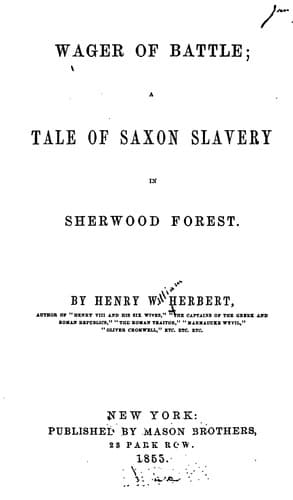
Wager of Battle: A Tale of Saxon Slavery in Sherwood ForestHerbert, Henry William
History
Wager of Battle: A Tale of Saxon Slavery in Sherwood Forest
Herbert, Henry William
Anglo-Saxons -- Fiction; Great Britain -- History -- Norman period, 1066-1154 -- Fiction; Sherwood Forest (England) -- Fiction
There, it would be a knot of sun-burned Saxon woodmen, in their green
frocks and buckram hose, with long bows in their hands, short swords
and quivers at their sides, and bucklers of a span-breadth on their
shoulders, men who had never acknowledged Norman king, nor bowed to
Norman yoke, who would stand at gaze, marking the party, from the
jaws of some bosky dingle, too proud to yield a foot, yet too few
to attack; proving that to be well accompanied, in those days, in
Sherwood, was a matter less of pomp than of sound policy. Anon,
receiving notice of their approach from the repeated bugle-blasts
of his verdurers, as they passed each successive _mere_ or
forest-station, a Norman knight or noble, in his garb of peace, would
gallop down some winding wood-path, with his slender train scattering
far behind him, to greet his brother in arms, and pray him to grace
his tower by refreshing his company and resting his fair and gentle
daughter for a few days or hours, within its precincts.
In short, whether in the forest or in the open country, scarcely an
hour, never a day, was passed, without their encountering some
pleasant sight, some amusing incident, some interesting adventure.
There was a vast fund of romance in the daily life of those olden
days, an untold abundance of the picturesque, not a little, indeed, of
what we should call stage-effect, in the ordinary habits and every-day
affairs of men, which we have now, in our busy, headlong race for
affluence, ambition, priority, in every thing good or evil,
overlooked, if not forgotten.
Life was in England then, as it was in France up to the days of the
Revolution, as it never has been at any time in America, as it is
nowhere now, and probably never will be any where again, unless we
return to the primitive, social equality, and manful independence of
patriarchal times; when truth was held truth, and manhood manhood, the
world over; and some higher purpose in mortality was acknowledged than
the mere acquiring, some larger nobleness in man than the mere
possessing, of unprofitable wealth.
Much of life, then, was spent out of doors; the mid-day meal, the
mid-day slumber, the evening dance, were enjoyed, alike by prince
and peasant, under the shadowy forest-tree, or the verdure of the
trellised bower. The use of flowers was universal; in every rustic
festival, of the smallest rural hamlets, the streets would be arched
and garlanded with wreaths of wild flowers; in every village hostelry,
the chimney would be filled with fresh greens, the board decked
with eglantine and hawthorn, the beakers crowned with violets and
cowslips, just as in our days the richest ball-rooms, the grandest
banquet-halls, are adorned with brighter, if not sweeter or more
beautiful, exotics.
Public-domain text, read in full here on John Shaqi.
Reviews
Reviews
No reviews yet
Be the first to share your thoughts on this work.
Elsewhere in the archive
Join the Discussion
Join the discussion
Sign in to leave a comment or review.
Sign InorCreate an account