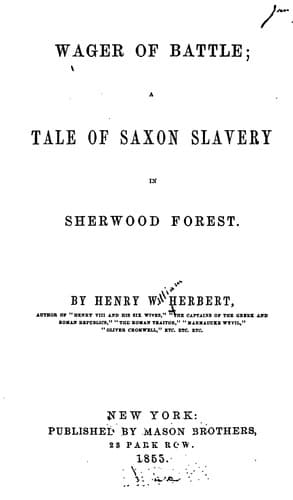
Wager of Battle: A Tale of Saxon Slavery in Sherwood ForestHerbert, Henry William
History
Wager of Battle: A Tale of Saxon Slavery in Sherwood Forest
Herbert, Henry William
Anglo-Saxons -- Fiction; Great Britain -- History -- Norman period, 1066-1154 -- Fiction; Sherwood Forest (England) -- Fiction
The great in those days had not lost "that touch of nature" which
"makes the whole world kin" so completely, as to see no grace in
simplicity, to find no beauty in what is beautiful alike to all, to
enjoy nothing which can be enjoyed by others than the great and
wealthy.
The humble had not been, then, bowed so low that the necessities had
precluded all thought, all care, for the graces of the existence of
man.
If the division between the noble and the common of the human race, as
established by birth, by hereditary rank, by unalterable caste, were
stronger and deeper and less eradicable than at this day, the real
division, as visible in his nature, between man and man, of the noble
and the common, the difference in his tastes, his enjoyments, his
pleasures, his capacity no less than his power of enjoying, was a mere
nothing then, to what it is to-day.
The servants, the very serfs, of aristocracy, in those days, when
aristocracy was the rule of blood and bravery, were not, by a
hundredth part, so far removed below the proudest of their lords, in
every thing that renders humanity graceful and even glorious, in every
thing that renders life enjoyable, as are, at this day, the workers
fallen below the employers, when nobility has ceased to be, and
aristocracy is the sway of capital, untinctured with intelligence, and
ignorant of gentleness or grace.
It is not that the capitalist is richer, and the operative
poorer--though this is true to the letter--than was the prince, than
was the serf of those days. It is not only that the aristocrat of
capital, the noble by the grace of gold, is ten times more arrogant,
more insulting, more soulless, cold-hearted, and calmly cruel, than
the aristocrat of the sword, the noble by the grace of God; and that
the worker is worked more hardly, clad more humbly, fed more sparely,
than the villain of the middle ages--though this, also, is true to the
letter--but it is, that the very tastes, the enjoyments, and the
capacities for enjoyment, in a word, almost the nature of the two
classes are altered, estranged, unalterably divided.
The rich and great have, with a few rare exceptions that serve only to
prove the rule, lost all taste for the simple, for the natural, for
the beautiful, unless it be the beautiful of art and artifice; the
poor and lowly have, for the most part, lost all taste, all perception
of the beautiful, of the graceful, in any shape, all enjoyment of any
thing beyond the tangible, the sensual, the real.
Public-domain text, read in full here on John Shaqi.
Reviews
Reviews
No reviews yet
Be the first to share your thoughts on this work.
Elsewhere in the archive
Join the Discussion
Join the discussion
Sign in to leave a comment or review.
Sign InorCreate an account