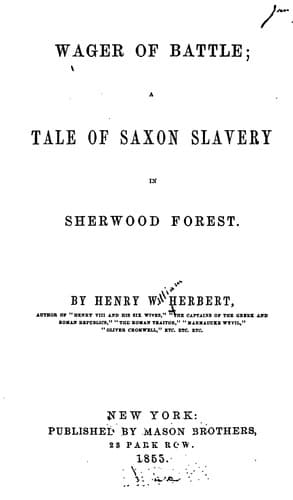
Wager of Battle: A Tale of Saxon Slavery in Sherwood ForestHerbert, Henry William
History
Wager of Battle: A Tale of Saxon Slavery in Sherwood Forest
Herbert, Henry William
Anglo-Saxons -- Fiction; Great Britain -- History -- Norman period, 1066-1154 -- Fiction; Sherwood Forest (England) -- Fiction
It is in this that lies the mortal sin, the never-dying reproach, of
him who would foster, would preserve, would propagate, the curse of
slavery; not that he is a tyrant over the body, but that he is a
destroyer of the soul--that he would continue a state of things which
reduces a human being, a fellow-man, whether of an inferior race or
no--for, as of congenerous cattle there are many distinct tribes, so
of men, and of Caucasian men too, there be many races, distinct in
physical, in moral, in animal, in intellectual qualities, as well as
in color and conformation, if not distinct in origin--to the level of
the beast which knoweth not whence he cometh or whither he goeth, nor
what is to him for good, or what for evil, which hopes not to rise or
to advance, either here or hereafter, but toils day after day,
contented with his daily food, and lies down to sleep, and rises up to
labor and to feed, as if God had created man with no higher purpose
than to sleep and eat alternately, until the night cometh from which,
on earth, there shall be no awakening.
But of this misery the Saxon serf was exempt: and, to do him justice,
of this reproach was the Norman conqueror exempt also. Of the use of
arms, and the knowledge of warfare, he indeed deprived his serfs, for
as they outnumbered him by thousands in the field, equalled him in
resolution, perhaps excelled him in physical strength, to grant such
knowledge would have been to commit immediate suicide--but of no other
knowledge, least of all of the knowledge that leads to immortality,
did he strive to debar him. Admittance to holy orders was patent to
the lowest Saxon, and in those days the cloister was the gate to all
knowledge sacred or profane, to all arts, all letters, all
refinements, and above all to that knowledge which is the greatest
power--the knowledge of dealing with the human heart, to govern
it--the knowledge, which so often set the hempen sandal of the Saxon
monk upon the mailed neck of the Norman king, and which, in the very
reign of which I write, had raised a low-born man of the common Saxon
race to be Archbishop of Canterbury, the keeper of the conscience of
the king, the primate, and for a time the very ruler of the realm.
Often, indeed, did the superior knowledge of the cowled Saxon avenge
on his masters the wrongs of his enslaved brethren; and while the
learned priesthood of the realm were the brethren of its most abject
slaves, no danger that those slaves should ever become wholly
ignorant, hopeless, or degraded--and so it was seen in the end; for
that very knowledge which it was permitted to the servile race to
gain, while it taught them to cherish and fitted them to deserve
freedom, in the end won it for them; at the expense of no floods of
noble blood, through the sordure and soil of no savage Saturnalia,
such as marked the emancipation alike of the white serfs of
revolutionized France, and the black slaves of disenthralled St.
Domingo.
Public-domain text, read in full here on John Shaqi.
Reviews
Reviews
No reviews yet
Be the first to share your thoughts on this work.
Elsewhere in the archive
Join the Discussion
Join the discussion
Sign in to leave a comment or review.
Sign InorCreate an account