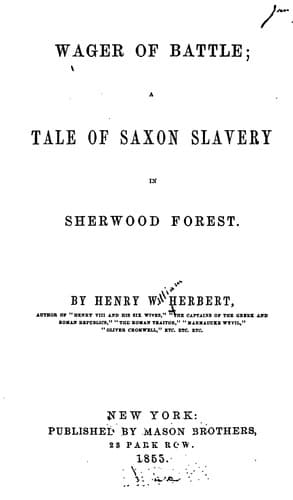
Wager of Battle: A Tale of Saxon Slavery in Sherwood ForestHerbert, Henry William
History
Wager of Battle: A Tale of Saxon Slavery in Sherwood Forest
Herbert, Henry William
Anglo-Saxons -- Fiction; Great Britain -- History -- Norman period, 1066-1154 -- Fiction; Sherwood Forest (England) -- Fiction
From this misery, from this last perversion and profanation of the
human intellect divine--the being content to be a slave--the Saxon
serf had escaped thus far; and, thanks to the great God of nature, of
revelation, that last curse, that last profanation, he escaped
forever. His body the task-master had enslaved; his intellect he had
emasculated, debased, shaken, but he had not killed it; for there,
there, amid the dust and ashes of the all-but-extinguished fire, there
lurked alive, ready to be enkindled by a passing breath into a
devouring flame, the sacred spark of liberty.
Ever hoping, ever struggling to be free, when the day dawned of
freedom, the Saxon slave was fit to be free, and became free, with no
fierce outbreak of servile rage and vengeance, consequent on servile
emancipation, but with the calm although enthusiastical gladness which
fitted him to become a freeman, a citizen, and, as he is, the master
of one half of the round world. It is not, ah! it is not the chain, it
is not the lash, it is not the daily toil, it is not the disruption of
domestic ties and affections, that prove, that constitute the sin, the
sorrow, and the shameful reproach of slavery.
Ah! no. But it is the very converse of these--the very point insisted
on so complacently, proclaimed so triumphantly, by the advocates of
this accursed thing--it is that, in spite of the chain, in spite of
the lash, in spite of the enforced labor, in spite of the absence or
disruption of family ties and affections, the slave is sleek,
satisfied, self-content; that he waxes fat among the flesh-pots; that
he comes fawning to the smooth words, and frolics, delighted, fresh
from the lash of his master, in no wise superior to the spaniel,
either in aspiration or in instinct. It is in that he envies not the
free man his freedom, but, in his hideous lack of all self-knowledge,
self-reliance, self-respect, is content to be a slave, content to eat,
and grow fat and die, without a present concern beyond the avoidance
of corporeal pain and the enjoyment of sensual pleasure, without an
aspiration for the future, beyond those of the beasts, which graze and
perish.
Public-domain text, read in full here on John Shaqi.
Reviews
Reviews
No reviews yet
Be the first to share your thoughts on this work.
Elsewhere in the archive
Join the Discussion
Join the discussion
Sign in to leave a comment or review.
Sign InorCreate an account