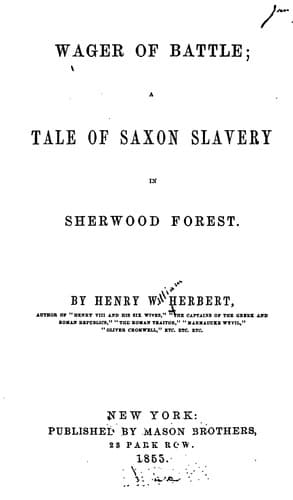
Wager of Battle: A Tale of Saxon Slavery in Sherwood ForestHerbert, Henry William
History
Wager of Battle: A Tale of Saxon Slavery in Sherwood Forest
Herbert, Henry William
Anglo-Saxons -- Fiction; Great Britain -- History -- Norman period, 1066-1154 -- Fiction; Sherwood Forest (England) -- Fiction
Kenric had been always a thinker, though a serf; his elder brother had
been a monk, a man of strong sense and some attainment; his mother had
been the daughter of one who had known, if he had lost, freedom. With
his mother's milk he had imbibed the love of freedom; from his
brother's love and teachings he had learned what a freeman should be;
by his own passionate and energetic will he had determined to become
free. He would have become so ere long, had not accident anticipated
his resolve; for he had laid by, already, from the earnings of his
leisure hours, above one half of the price whereby to purchase
liberty. He was now even more thoughtful and calmer; but his step was
freer, his carriage bolder, his head was erect. He was neither afraid
to look a freeman in the eye, nor to render meet deference to his
superior. For the freeman ever knows, nor is ashamed to acknowledge,
that while the equality of man in certain rights, which may be called,
for lack of a better title, natural and political, is co-existent with
himself, inalienable, indefeasible, immutable, and eternal, there is
no such thing whatever, nor can ever be, as the equality of man in
things social, more than there can be in personal strength, grace, or
beauty, in the natural gifts of intellect, or in the development of
wisdom. Of him who boasts that he has no superior, it may almost be
said that he has few inferiors.
Thereof Kenric--as he rode along with his harness on his back, and his
weapons in his hand, a freeman among freemen, a feudal retainer among
the retainers, some Norman, some Saxon, of his noble lord--was neither
louder, nor noisier, nor more exultant, perhaps the reverse, than his
wont, though happier far than he had conceived it possible for him to
be.
And by his bearing, his comrades and fellows judged him, and ruled
their own bearing toward him. The Saxons of the company naturally
rejoiced to see their countryman free by his own merit, and, seeing
him in all things their equal, gladly admitted him to be so. The
haughtier Normans, seeing that he bore his bettered fortunes as
became a man, ready for either fortune, admitted him as one who
had won his freedom bravely, and wore it as if it had been his from
his birth--they muttered beneath their thick mustaches, that he
deserved to be a Norman.
Edith, on the contrary, young yet, and unusually handsome, who had
been the pet of her own people, and the favorite of her princely
masters, who had never undergone any severe labor, nor suffered any
poignant sorrow, who knew nothing of the physical hardships of
slavery, more than she did of the real and tangible blessings of
liberty, had ever been as happy and playful as a kitten, and as
tuneful as a bird among the branches.
Public-domain text, read in full here on John Shaqi.
Reviews
Reviews
No reviews yet
Be the first to share your thoughts on this work.
Elsewhere in the archive
Join the Discussion
Join the discussion
Sign in to leave a comment or review.
Sign InorCreate an account