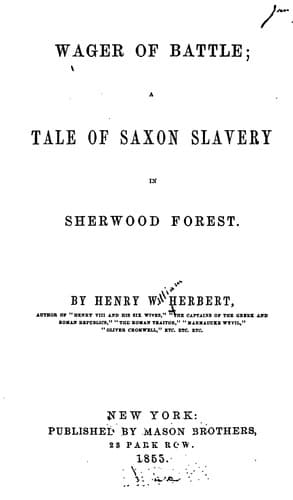
Wager of Battle: A Tale of Saxon Slavery in Sherwood ForestHerbert, Henry William
History
Wager of Battle: A Tale of Saxon Slavery in Sherwood Forest
Herbert, Henry William
Anglo-Saxons -- Fiction; Great Britain -- History -- Norman period, 1066-1154 -- Fiction; Sherwood Forest (England) -- Fiction
But now her voice was silent of spontaneous song, subdued in
conversation, full fraught with a suppressed deeper feeling. The very
beauty of the fair face was changed, soberer, more hopeful, farther
seeing, full no longer of an earthly, but more with something of an
angel light.
The spirit had spoken within her, the statue had learned that it had a
soul.
And Guendolen had noted, yet not fully understood the change or its
nature. More than once she had called her to her bridle-rein and
conversed with her, and tried to draw her out, in vain. At last, she
put the question frankly--
"You are quieter, Edith, calmer, sadder, it seems to me," she said,
"than I have ever seen you, since I first came to Waltheofstow. I have
done all that lies in me to make you happy, and I should be sorry that
you were sad or discontented."
"Sad, discontented! Oh! no, lady, no!" she replied, smiling among her
tears. "Only too happy--too happy, to be loud or joyous. All happiest
things, I think, have a touch of melancholy in them. Do you think,
lady, yonder little stream," pointing to one which wound along by the
roadside, now dancing over shelvy rapids, now sleeping in silent
eddies, "is less happy where it lies calm and quiet, reflecting
heaven's face from its deep bosom, and smiling with its hundred
tranquil dimples, than where it frolics and sings among the pebbles,
or leaps over the rocks which toss it into noisy foam-wreaths? No!
lady, no. There it gathers its merriment and its motion, from the mere
force of outward causes; here it collects itself from the depth of its
own heart, and manifests its joy and love, and thanks God in silence.
It is so with me, Lady Guendolen. My heart is too full for music, but
not too shallow to reflect boundless love and gratitude forever."
The lady smiled, and made some slight reply, but she was satisfied;
for it was evident that the girl's poetry and gratitude both came
direct from her heart; and in the smile of the noble demoiselle there
was a touch of half-satiric triumph, as she turned her quick glance to
Sir Yvo, who had heard all that passed, and asked him, slyly, "And do
you, indeed, think, gentle father, that these Saxons are so hopelessly
inferior, that they are fitting for nothing but mere toil; or is this
the mere inspiration that springs from the sense of freedom?"
Public-domain text, read in full here on John Shaqi.
Reviews
Reviews
No reviews yet
Be the first to share your thoughts on this work.
Elsewhere in the archive
Join the Discussion
Join the discussion
Sign in to leave a comment or review.
Sign InorCreate an account