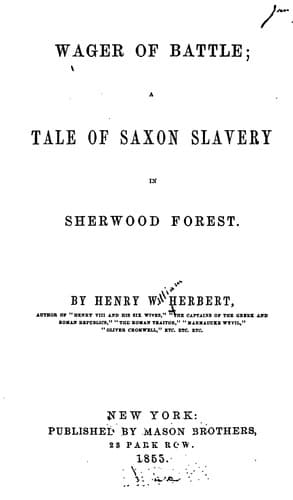
Wager of Battle: A Tale of Saxon Slavery in Sherwood ForestHerbert, Henry William
History
Wager of Battle: A Tale of Saxon Slavery in Sherwood Forest
Herbert, Henry William
Anglo-Saxons -- Fiction; Great Britain -- History -- Norman period, 1066-1154 -- Fiction; Sherwood Forest (England) -- Fiction
"I think, indeed," he replied, "that my little Guendolen is but a
spoiled child at the best; and, as to my thoughts in regard to the
Saxons, them I shall best consult my peace of mind and pocket by
keeping my own property; since, by our Lady's Grace! you may take it
into your head to have all the serfs in the north emancipated; and
that is a little beyond my powers of purchase. But see, Guendolen, see
how the sunbeams glint and glitter yonder on the old tower of Barden,
and how redly it stands out from those purple clouds which loom so
dark and thunderous over the peaceful woods of Bolton. Give your
jennet her head, girl, and let her canter over these fair meadows,
that we may reach the abbey and taste the noble prior's hospitality
before the thunder gust is upon us."
And quickening its pace, the long train wound its way upward, by the
bright waters of the beautiful Wharfe, and speedily obtained the
shelter, and the welcome they expected from the good and generous
monks of Bolton, the noblest abbaye in the loveliest dale of all the
broad West Riding.
The next morning found them traversing the broken green country that
lies about the head of the romantic Eyre, and threading the wild
passes of Ribbledale, beneath the shadow of the misty peaks of
Pennigant and Ingleborough, swathed constantly in volumed vapor,
whence the clanging cry of the eagle, as he wheeled far beyond the ken
of mortal eyes, came to the ears of the voyagers, on whom he looked
securely down as he rode the storm.
That night, no castle or abbey, no village even, with its humble
hostelry, being, in those days, to be found among those wild fells and
deep valleys, bowers were built of the materials with which the
hillsides were plentifully feathered throughout that sylvan and
mountainous district, of which the old proverbial distich holds good
to this very day:
"O! the oak, the ash, and the bonny ivy tree,
They flourish best at home in the north countree."
Young sprouts of the juniper, soft ferns, and the delicious purple
heather, now in its most luxurious flush of summer bloom and perfume,
furnished agreeable and elastic couches; and, as the stores carried by
the sumpter mules had been replenished by the large hospitality of the
prior of Bolton, heronshaw and egret, partridge and moorgame, wildfowl
and venison, furnished forth their board, with pasties of carp and
eels, and potted trout and char from the lakes whither they were
wending, and they fared most like crowned heads within the precincts
of a royal city, there, under the shadow of the gray crags and bare
storm-beaten brow of bleak Whernside, there where, in this nineteenth
century, the belated wayfarer would deem himself thrice happy, if he
secured the rudest supper of oat-cakes and skim-milk cheese, with a
draught of thin ale, the luxuries of the hardy agricultural population
of the dales.
CHAPTER XIV.
THE NEW HOME.
Public-domain text, read in full here on John Shaqi.
Reviews
Reviews
No reviews yet
Be the first to share your thoughts on this work.
Elsewhere in the archive
Join the Discussion
Join the discussion
Sign in to leave a comment or review.
Sign InorCreate an account